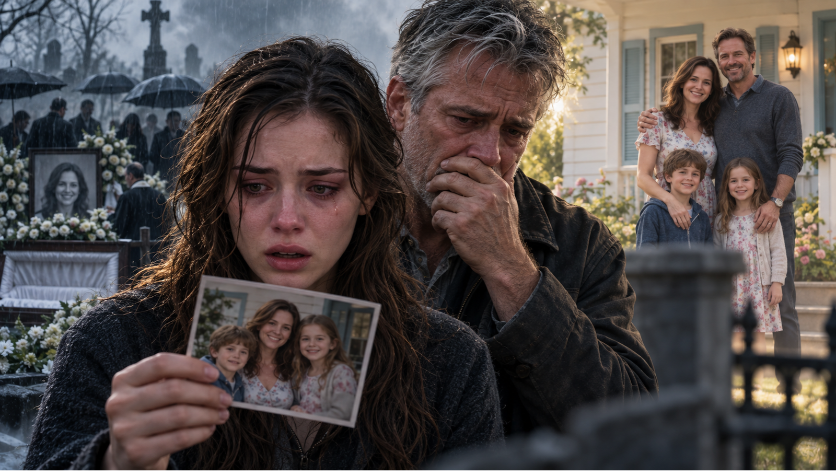
The first thing Audrey Whitlock learned about her mother’s death was that the State of Pennsylvania had no record of it.
The second was that the woman who had supposedly been buried eleven years earlier had renewed her driver’s license in Connecticut just six months ago.
Audrey was twenty years old. She had spent more than half her life visiting an empty grave, and until that Wednesday morning, she had never thought to question why the cemetery had no photograph of her mother on file.
It began with a scholarship.
Not a particularly generous scholarship, considering the cost of university tuition, but enough to cover Audrey’s final two years at Temple University if she could prove that she qualified for the dependent survivor provision attached to a state educational assistance program.
The application required a certified copy of her mother’s death certificate.
Her father couldn’t find it.
He searched the filing cabinet in his bedroom, the lockbox in the hall closet, and a battered accordion folder containing tax returns, old insurance policies, and medical receipts dating back to before Audrey was born.
After two hours, he came downstairs carrying a cardboard box.
“Everything from that year should be in here.”
Audrey looked inside.
There were photographs of Christmases she barely remembered, an expired passport, a receipt from a children’s dentist, and a hospital bracelet with her name printed in faded purple letters.
No death certificate.
Her father, Graham Whitlock, stood beside the dining table with his hands on his hips.
He was fifty-one, broad-shouldered, with prematurely silver hair and the permanently exhausted expression of a man who had spent twenty-six years repairing other people’s plumbing.
“I’m sorry, sweetheart.”
“It’s fine. I’ll request a replacement.”
He nodded, although his eyes remained fixed on the box.
Audrey watched him.
“You okay?”
“Yeah.”
“Dad.”
He sat down.
“I haven’t opened some of that stuff in years.”
Audrey reached across the table and touched his hand.