DEVON, ENGLAND – A young fox left unable to walk on his hind legs after a road accident has formed an unexpected friendship with an elderly Golden Retriever, whose calm companionship helped the frightened animal adjust to life in a specialist wildlife care facility.
The fox, later named Jasper, was discovered beside a rural road outside Exeter on a rainy November morning.
A passing driver noticed the small red fox attempting to drag himself away from the roadside using only his front legs.
His hindquarters remained motionless.
When a wildlife rescue team arrived, Jasper was lying beneath a hedge, trembling and breathing rapidly.
His reddish-brown coat was soaked, tangled with mud and leaves, and marked with small abrasions along his side.
He tried to crawl away when rescuers approached but could move only a few inches.
The team carefully secured him in a ventilated carrier and transported him to a wildlife veterinary clinic.
Examinations revealed a serious spinal injury consistent with being struck by a vehicle.
Although Jasper survived, veterinary specialists found that he had lost significant movement in both hind legs.
Despite treatment and rehabilitation, his mobility did not recover sufficiently for him to survive independently in the wild.
The rescue organisation began preparing for long-term specialist care.
Several weeks later, Jasper was transferred to a licensed wildlife rehabilitation facility managed by volunteer caretaker Eleanor Hughes.
His injuries had stabilised, and his coat was clean again, but his behaviour remained withdrawn.
He spent much of his first day curled in the far corner of his enclosure.
He avoided unfamiliar sounds, refused food while anyone was watching, and retreated whenever a caretaker approached.
Eleanor placed a covered sleeping area and soft bedding nearby, giving him space to settle.
But another animal living at the facility soon became part of Jasper’s recovery story.
His name was Moka.
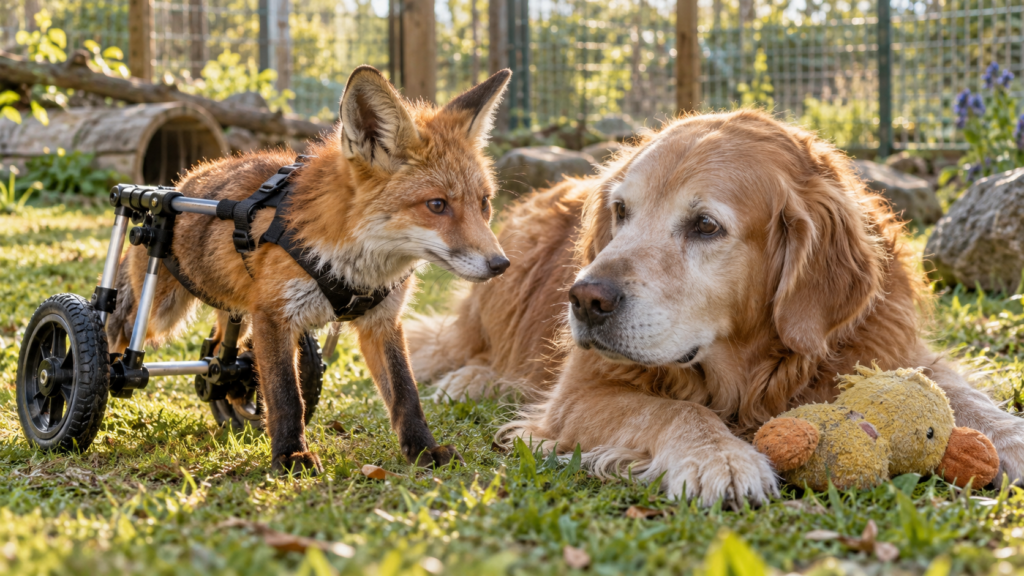
Moka was a twelve-year-old Golden Retriever with a greying muzzle, gentle brown eyes, and a noticeably slow walk caused by age-related arthritis.
He had lived with Eleanor for years and was known for his relaxed temperament around other animals.
At first, Jasper and Moka were kept completely separate.
The wildlife team understood that a domestic dog could frighten or injure a fox, regardless of how gentle the dog appeared.
Only after veterinary and behavioural assessments did staff arrange brief, closely supervised introductions.
During their first meeting, Jasper remained inside a secure enclosure.
Moka approached slowly, carrying a faded yellow plush toy.
He paused several feet away, lowered the toy onto the grass, and settled down beside Eleanor.
Jasper watched him from his hiding place.
Nothing else happened.
The following afternoon, Moka returned with the same toy.
Again, he lay quietly at a distance.
Over several supervised sessions, Jasper gradually began spending more time near the front of his enclosure.
His ears remained alert, but he no longer retreated immediately when the elderly dog appeared.
One afternoon, Jasper slowly pulled himself toward the mesh partition separating them.
Moka lifted his head.
For several seconds, the two animals watched each other.
Then Moka lowered his muzzle back onto his paws.
Jasper settled on his bedding nearby.
It was the first time Eleanor had seen the young fox resting so openly while another animal was close.
Meanwhile, Jasper’s rehabilitation team was working on a different challenge.
Although his front legs remained strong, dragging his hindquarters across the ground risked skin injuries and limited his movement.
A veterinary rehabilitation specialist recommended a custom two-wheeled mobility cart designed to support his pelvis and hind legs.
The equipment was carefully fitted to Jasper’s body, with padded supports and adjustable straps.
His first attempt was difficult.
He froze when placed in the device.
Then he took two short steps forward before stopping.
The unfamiliar wheels made a soft rattling sound against the ground.
Jasper turned his head toward them and refused to continue.
The team ended the session and allowed him to rest.
Over the following days, they introduced the cart in short, supervised sessions, rewarding voluntary movement and checking frequently for discomfort.
During one session, Moka was resting behind a secure partition beside the exercise area.
Jasper noticed him.
He lifted his head, moved his front paws forward, and rolled the cart a few inches toward the fence.
Moka stood slowly and walked along the other side.
Jasper followed.
The elderly Golden Retriever stopped after several steps.
So did Jasper.
Then Moka continued.
And Jasper moved again.
The rehabilitation team watched as the young fox crossed more of the exercise area than he had during previous sessions.
Nobody could know whether Jasper was deliberately following the dog or simply responding to a familiar presence.
But the interaction appeared to encourage him to explore.
Over the following weeks, Jasper became more comfortable using his cart.
He learned to navigate flat pathways, turn around obstacles, and move through a specially adapted outdoor enclosure.
His mobility remained limited, and the device was used only under supervision.
But the difference was unmistakable.
The fox who had once struggled to move a few inches could now explore safely without dragging his injured hindquarters.
Several months after his rescue, Eleanor recorded a quiet afternoon in the facility’s enclosed garden.
Moka walked slowly along a grassy path.
A short distance away, Jasper moved through the grass in his two-wheeled cart, pausing occasionally to investigate unfamiliar scents.
When Moka settled beneath a tree, Jasper approached the other side of the partition and lay down.
The elderly dog rested his head on his paws.
Jasper tucked his front legs beneath his chest.
They remained there together in the afternoon sunlight.
Jasper would never return to the wild.
He would continue needing specialist veterinary attention, protected accommodation, and mobility support.
But he was no longer the frightened fox struggling beside a road.
And Moka, who had spent most of his life moving at an increasingly gentle pace, had become a familiar companion during his recovery.
One had lost the ability to run.
The other had grown too old to run very far.
But together, they had found a pace that suited them both.