LANCASTER COUNTY, PENNSYLVANIA
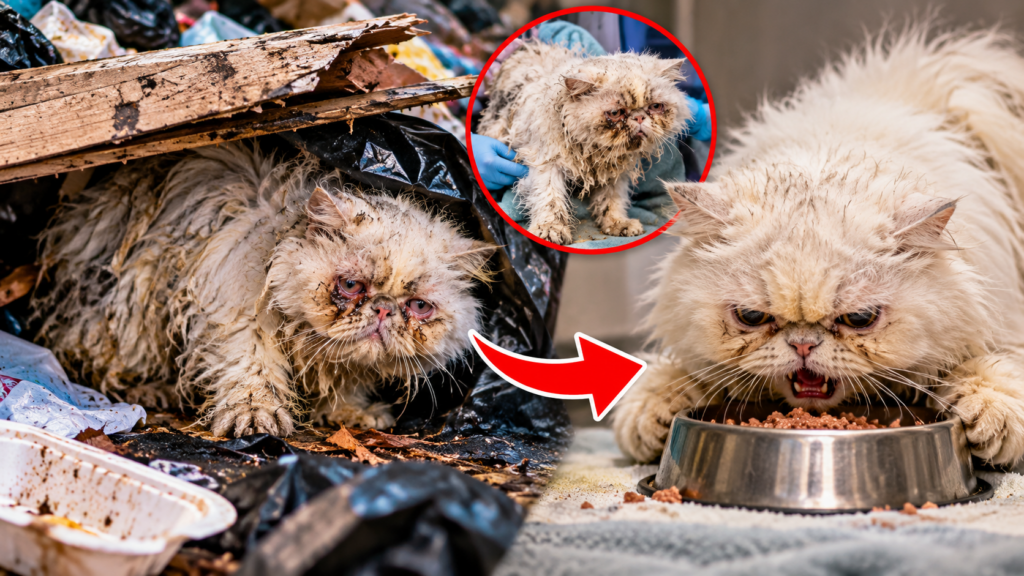
When rescuers discovered an elderly Persian cat lying beside a pile of discarded furniture, they could barely recognise the beautiful animal beneath her filthy, tangled coat.
Her name was Duchess.
Once bred for her luxurious platinum-white fur and distinctive flat face, Duchess had reportedly spent most of her life confined inside a commercial breeding facility.
Now, at approximately nine years old, she was severely underweight, suffering from untreated eye infections, and covered in thick mats of fur contaminated with waste.
Her eyes were swollen and crusted with discharge. Several areas of skin beneath the tangled coat were painfully irritated.
She had apparently been abandoned after she was no longer considered useful for breeding.
But even after volunteers carried her to safety, Duchess remained terrified of something most household cats took for granted.
Food.
Whenever a bowl was placed in front of her, she ate frantically, growling between mouthfuls and crouching protectively over the dish.
She behaved as though another animal might appear at any moment and take everything away.
And it would take months of gentle care before Duchess could finally eat without constantly looking over her shoulder.
The cat behind the wire
Duchess had once been one of several female Persian cats kept in a secluded breeding operation outside Lancaster.
From the outside, the building appeared to be an ordinary agricultural storage facility.
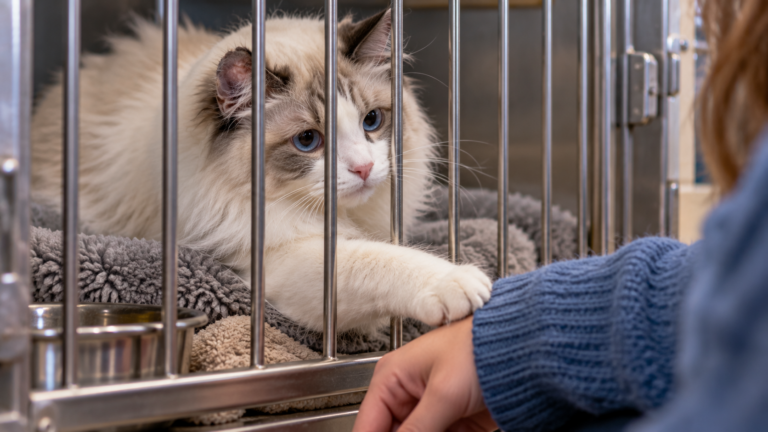
Inside, rows of wire cages stood along narrow corridors.
The cages held long-haired cats of different ages and colours, some with kittens curled beside them.
Duchess occupied a lower enclosure near the back wall.
Her cage was barely large enough to accommodate a litter tray, two metal bowls, and a small resting area.
There was little room to stretch comfortably.
The wire flooring was partially covered with old, damp newspaper.
Her food bowl was often surrounded by spilt litter and dried waste.
When workers entered the room, Duchess typically retreated to the back of her cage.
Her long white fur had become tangled from inadequate grooming.
At first, small knots developed behind her ears and along her belly.
Over time, those knots tightened into dense mats.
The fur around her hindquarters became stained and clumped.
Damp patches pressed against her skin, causing irritation that worsened without proper care.
Like many Persian cats, Duchess also required regular attention to her eyes and facial folds.
But her face was rarely cleaned adequately.
Dark discharge accumulated beneath her eyes.
Eventually, the surrounding skin became inflamed.
Duchess frequently rubbed her face against the cage bars, trying to relieve the discomfort.
There were days when she barely opened her eyes.
The breeding records later recovered by investigators were incomplete, but they suggested she had produced multiple litters over several years.