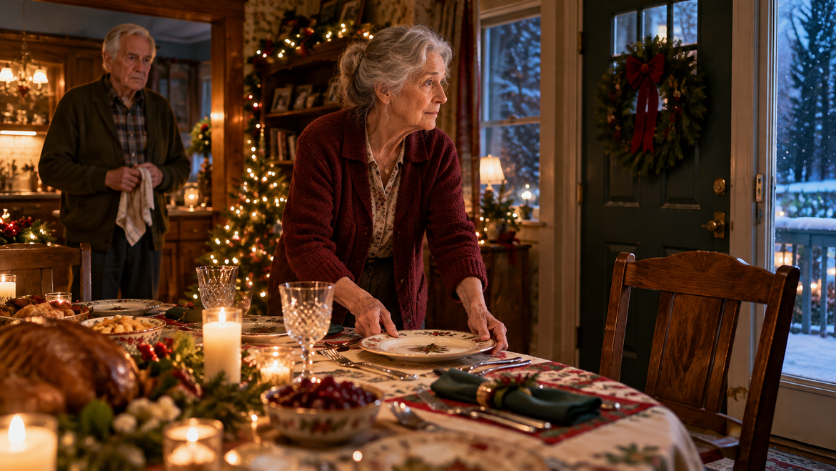
For eleven years, Margaret Whitmore set an extra place at Christmas dinner for the son who had stopped coming home. Her daughter called it a foolish habit. Her husband quietly put the unused plate away every January. But when Margaret died three weeks before Christmas, the family discovered that the empty chair had never been waiting for the person they thought.
Chapter One: The House on Willow Lane
On the morning of December third, Margaret Whitmore stood in her kitchen in the small Vermont town of Bellweather and wrote four names on the back of an old grocery receipt.
Daniel. Emily. Sophie. Thomas.
She studied the list while the kettle rattled on the stove. Daniel lived in Portland, Maine, with a wife she had met twice and a daughter she knew mostly through photographs. Emily lived twenty minutes away and telephoned every Sunday, usually while driving between errands. Sophie, Emily’s sixteen-year-old daughter, had recently begun visiting on Wednesday afternoons, though she spent much of the time looking at her phone. Thomas was Margaret’s husband of forty-seven years, and at that moment he was upstairs searching for a pair of slippers that had been beside his bed when he woke.
There should have been five names.
Margaret turned the receipt over and began writing her Christmas grocery list.
At seventy-three, she had developed the habit of making preparations earlier than necessary. The Christmas pudding was already wrapped in muslin in the pantry. She had bought batteries for the little wooden village that Thomas liked to arrange along the sitting-room windowsill. There were three rolls of wrapping paper beneath the guest-room bed, though she had not yet bought any presents.
The kitchen window overlooked a narrow backyard where the first snow had settled over the birdbath. Margaret watched a sparrow land on its frozen rim and peck at the ice.
Thomas came downstairs wearing one slipper and a wool sock.
“Have you seen the other one?”
“Under your chair, I expect.”
“I looked.”
“Did you move the chair?”
He considered this. “No.”
She smiled and turned back to the kettle.
It was the kind of exchange they had been having for nearly half a century. When they were young, Thomas had been an electrician, capable of tracing a faulty wire through three floors of an unfamiliar house, yet unable to locate a clean shirt without assistance. Margaret had taught elementary school for thirty-two years and could remember the birthdays of children she had not seen since 1987. Between them, they had raised two children, paid off a mortgage, buried four parents, and learned that a long marriage consisted largely of small inconveniences willingly endured.
Thomas found his slipper exactly where she had said it would be.