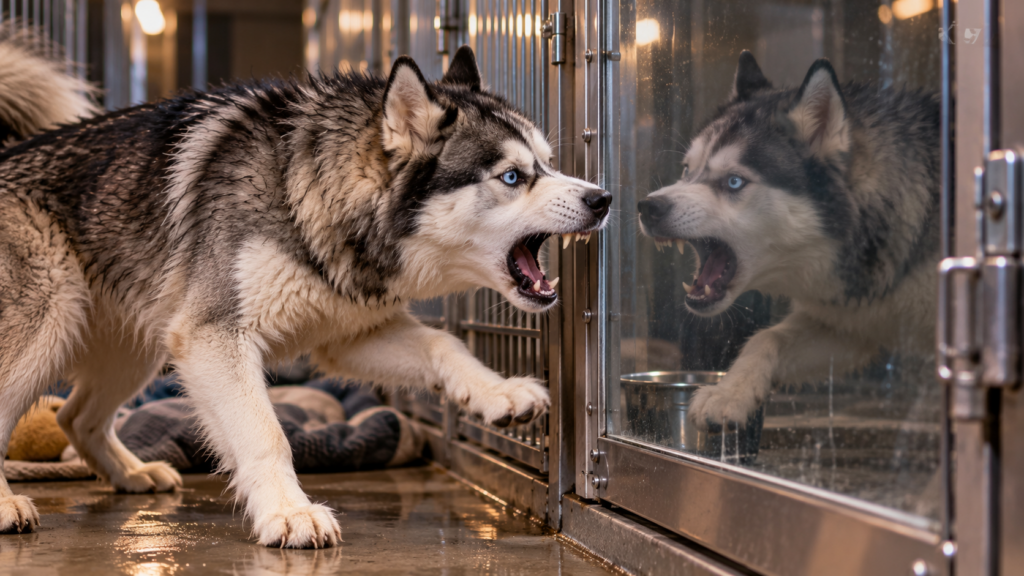
DENVER, COLORADO – Every evening, just as the lights come on in the kennel corridor, a rescued Siberian Husky named Ghost begins barking desperately at the glass door of his enclosure.
The four-year-old Husky approaches the glass, stiffens, and suddenly lunges forward.
He barks at the image in front of him, retreats several steps, circles his kennel, and returns to confront it again.
Sometimes the behaviour continues for nearly twenty minutes.
Shelter staff initially believed Ghost was reacting to people walking outside his enclosure.
But the barking continued even when the hallway was completely empty.
The dog Ghost appeared to be confronting was his own reflection.
Ghost had arrived at the shelter six weeks earlier after animal welfare officers removed him from a vacant commercial property on the outskirts of Denver.
At the time of his rescue, his white-and-gray coat was filthy, with matted patches around his hindquarters and dried dirt covering his paws.
He was underweight, and several small, healed scars were visible along his muzzle.
Veterinary examinations found no serious ongoing physical injuries, although Ghost showed signs of prolonged stress.
After several weeks of treatment, grooming, regular meals, and exercise, his coat became clean and healthy.
He began accepting treats from familiar volunteers and enjoyed running through the shelter’s outdoor exercise yard.
But each evening, the barking returned.
The first incident was documented by volunteer Sarah Mitchell during her regular closing shift.
At approximately 7:15 p.m., Sarah heard Ghost barking repeatedly from the far end of the corridor.
When she approached, she found him standing rigidly in front of his glass kennel door.
His ears were upright.
His tail was tense.
And his pale blue eyes remained fixed on the surface directly ahead.
He suddenly lunged at the glass, then jumped backward.
“Ghost, sweetheart, there’s nobody there.”
But Ghost continued staring.
Sarah stepped away from the kennel.
The hallway was backwards.
Still, Ghost began barking again.
Over the following week, staff reviewed security recordings and noticed a consistent pattern.
Thebehaviourr occurred most frequently after sunset, when the kennel interior was brightly illuminated while the corridor beyond the glass remained comparatively dark.
Under those conditions, the glass reflected Ghost’s movements clearly.
When he approached, the reflected Husky approached.
When he retreated, the image retreated.
And when he lunged, the image appeared to lunge back.
The staff wondered whether the reflection was triggering a fear response rather than ordinary territorial barking.
They began reviewing Ghost’s rescue records.
Ghost had been discovered inside a small office at an abandoned vehicle repair facility.
The office had glass partitions separating it from the workshop.
According to the original welfare report, officers found deep scratches near the lower edges of the partition and damage around the door.
Several reflective panels lined the narrow room.
A former worker who later contacted investigators reported that Ghost had occasionally been confined inside the office while equipment was moved through the workshop.
The worker described hearing the Husky barking and repeatedly striking the glass whenever shadows or movements appeared on the opposite side.
The room had limited enrichment, and the dog reportedly spent long periods alone.
Investigators could not establish how frequently Ghost had been confined there or whether he had previously experienced other frightening encounters.
However, the information raised concerns about his prolonged exposure to an enclosed, reflective environment.
The shelter’behaviouralal team suspected that reflections and restricted spaces had become associated with frustration or fear.
They also cautioned that Ghost might not recognize his reflection as himself.
Dogs do not necessarily interpret mirror images the way humans do, and reactions can vary conrecognise.
For an already anxious animal, a moving reflection in a confined space may be particularly unsettling.
Staff decided to test whether reducing the reflection would help.
They attached an opaque covering to the lower half of Ghost’s glass kennel door, leaving adequate visibility and ventilation.
That evening, Ghost approached the entrance as usual.
He lowered his head toward the glass.
But the familiar moving image was gone.
He stood there for several seconds.
Then he sniffed the bottom of the door and walked back toward his bed.
For the first time in days, he did not begin his usual barking routine.
Over the following week, the change remained noticeable.
Ghost still became alert when unfamiliar sounds echoed through the corridor, and he occasionally paced before settling.
But the repeated lunging at the glass became much less frequent.
Staff also introduced predictable evening routines and additional enrichment activities to help him decompress.
One evening, Sarah checked on Ghost shortly after the corridor lights were dimmed.
The Husky was lying on his bed, his clean gray-and-white fur resting against a soft blanket.
He lifted his head when she passed.
His ears moved toward her footsteps.
Then he lowered his muzzle back onto his paws.
He did not rush toward the glass.
He did not bark.
Sarah stood quietly for a moment before continuing down the hallway.
Ghost’s behavioural rehabilitation was still ongoing, and the shelter could not know exactly what experiences had contributed to his reactions.
But one small environmental change had made a meaningful difference.
For weeks, Ghost had spent his evenings confronting a moving image that appeared whenever he approached the door.
Once the reflection disappeared, he finally had one less thing to fear.