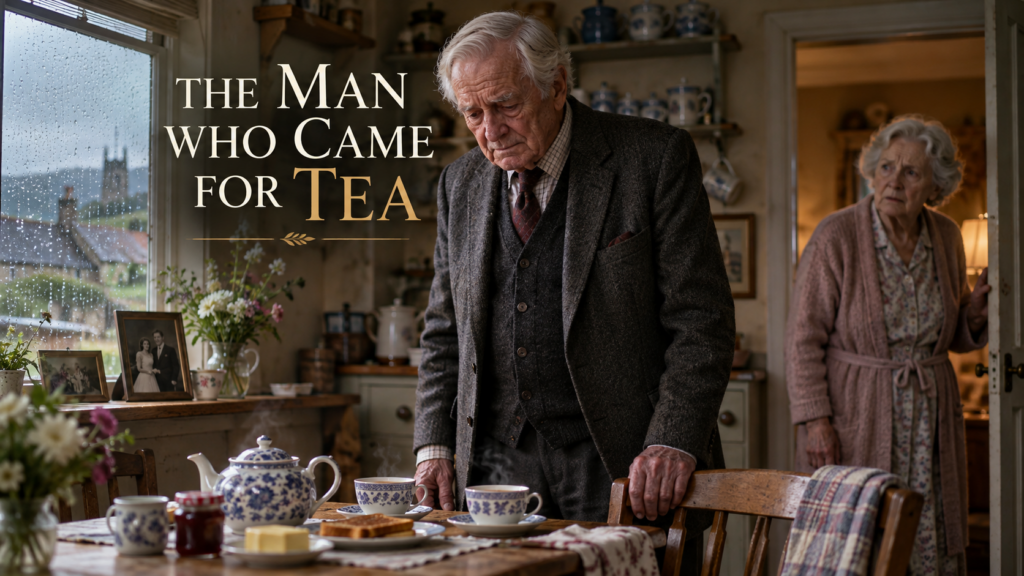
The first thing May Whitaker forgot was where she had put the good scissors.
She had owned them for thirty-two years, ever since she bought them from a haberdashery in Harrogate after deciding that the scissors Jack kept in the kitchen were no longer fit for cutting fabric. They had black handles, one slightly larger than the other, and a small nick in the lower blade from the time she had used them to cut a piece of wire because Jack was taking too long to find his pliers.
They belonged in the second drawer of her sewing cabinet, beneath a folded square of blue cotton.
On a Thursday morning in October, she opened that drawer and found they were gone.
Jack was at the kitchen table, attempting to complete the crossword in the Yorkshire Post.
“Have you been at my sewing things?”
He looked up.
“No.”
“Are you certain?”
“Reasonably.”
“That’s not an answer.”
“It’s the best one I’ve got.”
May stood in the kitchen doorway with her hands on her hips. At seventy-six, she was still a handsome woman, with silver-grey hair cut just below her ears, straight shoulders, and the habit of narrowing her eyes when she suspected someone was being deliberately unhelpful.
She was wearing the green cardigan Jack had bought her for Christmas. One sleeve had a small darn near the wrist, almost invisible unless you knew where to look.
“The good scissors are missing.”
“Have you checked the drawer?”
“Of course I’ve checked the drawer.”
“Only asking.”
“Well, don’t.”
Jack returned to his crossword.
They had been married for fifty-two years, which was long enough for him to understand that the appropriate response to an accusation about missing household objects was neither an elaborate defence nor a counteraccusation. May would find the scissors eventually, and until then he would be suspected.
At half past ten, he went to make tea.
He found the scissors in the refrigerator, lying on the middle shelf beside a jar of pickled onions.
For a moment he stood with the door open.
Then he took them out, wiped the handles with a tea towel, and carried them into the sitting room.
“Found these.”
May looked up from her sewing.
“Where?”
“In the kitchen.”
“Where in the kitchen?”
He hesitated.
“Near the fridge.”
She held out her hand.
“Well, I must have put them down when I was getting the milk.”
“Probably.”
He gave them to her and returned to the kitchen.
Neither mentioned it again.
At the time, there seemed little reason to.
People misplaced things. They forgot appointments, repeated stories, walked into rooms and couldn’t remember why. Jack himself had once spent twenty minutes looking for his spectacles while they were sitting on top of his head.
May had laughed about that for a week.
The scissors became another domestic incident, mildly amusing and soon forgotten.
Except that Jack remembered it.
Years later, when he tried to identify the point at which their ordinary life had begun to change, he would return to that Thursday morning and the black-handled scissors lying cold beside the pickled onions.
Not because he ought to have known what they meant.
He couldn’t have known from that one incident.
But because he could still see May standing in the doorway, irritated rather than frightened, certain that the world remained a place in which everything misplaced could eventually be found.
The Whitakers lived in a stone cottage on the outskirts of Ilkley, where the houses gradually gave way to open fields and the distant rise of the moors.
The cottage had been built in the late nineteenth century and had belonged to Jack’s parents before he and May bought it from his sisters after their father died. Its walls were thick enough to keep the interior pleasantly cool in summer and infuriatingly cold in winter.
Jack had spent much of his retirement improving it.
He had insulated the loft, replaced the back door, fitted new shelves in the pantry, and repaired the low garden wall at least three times. May believed the wall required professional attention. Jack maintained that the problem was simply that Yorkshire winters were unkind to mortar.
Their disagreement had lasted fourteen years.
The house contained the usual evidence of a long marriage: furniture bought when money was scarce and kept after money became less scarce, photographs in frames that no longer matched, and cupboards filled with objects neither person remembered acquiring.
In the sitting room stood an oak cabinet containing May’s collection of china cups. She had inherited six from her mother, bought four at charity shops, and received several more as gifts.
Jack could never understand why anyone needed eighteen teacups when there were only two people living in the house.
May pointed out that he owned seven hammers.
“They’re different hammers.”
“And they’re different cups.”
“Mine have different purposes.”
“So do mine.”
That was generally the end of the argument.
Their only daughter, Helen, lived in Leeds with her husband and two teenage children. She visited most Sundays, often bringing groceries despite May’s insistence that they were perfectly capable of shopping for themselves.
Helen had inherited her father’s practicality and her mother’s determination, an unfortunate combination during family disagreements.
She worked as a secondary-school administrator, enjoyed gardening when she had time for it, and worried about her parents in ways she tried not to make obvious.
Their grandchildren, Sophie and Ben, had grown from small children who raided the biscuit tin into adolescents who preferred their phones to family conversation. May complained about this regularly but still made Ben’s favourite lemon drizzle cake whenever he visited.











