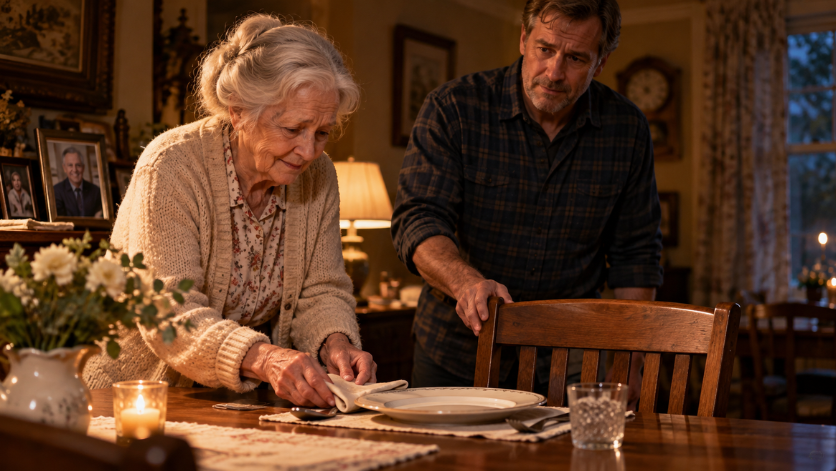
A literary family drama about a grandmother’s quiet sacrifices, a father’s unspoken love, and a daughter who discovers what home really means.
Chapter One – The Woman Who Set Four Places
The first time Eleanor Whitmore noticed that her grandmother was forgetting things, there were five plates on the dining table.
There had only ever been four people in the house.
“Grandma, who’s coming for dinner?”
Margaret Whitmore stood beside the kitchen counter, drying a perfectly clean glass with a tea towel. At seventy-nine, she had grown smaller than Eleanor remembered, though she still wore her silver hair pinned neatly at the back of her head and insisted on dressing properly for supper, even when no one was visiting.
“Your grandfather,” she answered.
Eleanor looked toward the empty chair at the head of the table.
Her grandfather had been dead for eleven years.
She glanced at her father, who was standing by the sink with his sleeves rolled to his elbows. Daniel Whitmore continued peeling potatoes, though the knife had stopped moving.
“Mother,” he said gently, “Dad isn’t coming tonight.”
Margaret looked at him with mild irritation.
“Don’t be ridiculous, Daniel. He’s only gone to fetch the newspaper.”
For several seconds, nobody spoke. Outside, rain tapped against the kitchen window, and the old radiator clicked as it struggled to warm the room.
Then Daniel put down the potato, washed his hands, and pulled out the fifth chair.
“All right,” he said. “We’ll keep his place.”
Margaret smiled, satisfied, and returned to the stove.
Eleanor watched her father straighten the chair and place a folded napkin beside the empty plate. He did it with the same careful attention he had once given to tying her school shoes, checking the oil in her first car, and wrapping Christmas presents with so much tape that opening them required scissors.
She had always mistaken that kind of care for an inability to express himself.
At thirty-two, Eleanor had built a life in Boston that left little room for the small Pennsylvania town where she had grown up. She worked for an architectural firm, rented an apartment overlooking the Charles River, and called her father every Sunday, usually while buying groceries or waiting for her laundry to finish.
He never complained that she was distracted.
He always asked whether she was eating properly.
That evening, she had driven four hours after receiving a telephone call from her father’s neighbor, who said Margaret had been found walking along the highway in her slippers.
Her grandmother had been looking for the elementary school where Daniel attended third grade.
Daniel was fifty-eight.
Eleanor had expected confusion, perhaps embarrassment, when she arrived. Instead, her grandmother had opened the door, embraced her, and immediately complained that she looked too thin.