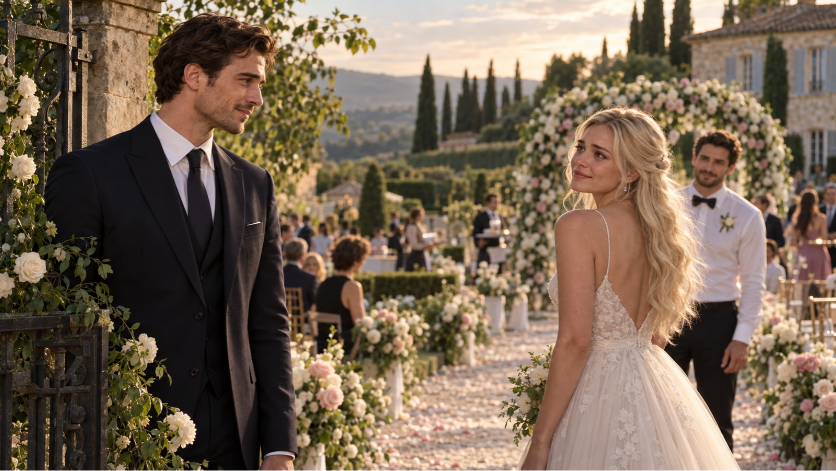
The first time Maria Bennett met Julian Hayes, he was standing in the rain outside a bookstore, trying to save a paper bag full of oranges.
It was an unusually wet Thursday in early October, and the sidewalk outside the shop had become a shallow river. Julian had been attempting to balance his groceries beneath a newspaper when the bottom of the bag gave way. Six oranges escaped in different directions.
Maria caught one with the toe of her boot.
“Good reflexes,” he said.
“Terrible packaging.”
“Also true.”
He was twenty-six then, tall and broad-shouldered, with dark brown hair that curled slightly at the collar of his coat. His face had the easy, open quality of someone who expected the world to be reasonably kind to him, even when it was raining and his groceries were rolling into traffic.
Maria was twenty-three, with long platinum-blonde hair that had escaped the hood of her camel coat. She held out the rescued orange.
“How many have you lost?”
“Emotionally or financially?”
She laughed, and he smiled at the sound.
He offered to buy her coffee as repayment. She refused because she had a dinner reservation with her father. He asked if he could buy her coffee another day.
She considered him for a moment.
“Only if you promise not to bring fruit.”
That was how it began.
Years later, Julian would try to remember the exact colour of her coat, the books she had been carrying, the way she’d tucked a wet strand of hair behind her ear. He would remember all those things with painful precision.
What he would struggle to remember was the exact moment he began taking her for granted.
Maria grew up in a handsome Georgian house in Richmond, southwest London, where the windows overlooked a garden her mother had planted before Maria was old enough to appreciate it.
There were climbing roses against the brick wall, lavender along the path, and a pear tree that leaned slightly toward the kitchen.
Her father, Richard Bennett, owned a successful architectural practice. His wealth was comfortable rather than theatrical. He preferred old watches, well-made shoes, and holidays spent hiking somewhere without reliable phone reception.
Maria’s mother, Eleanor, had been the warmth at the centre of their household.
She had taught Maria how to make lemon cake without a recipe, how to choose flowers that would survive the winter, and how to apologise without making excuses.
When Maria was nineteen, Eleanor was killed in a road accident on a wet November afternoon.
Afterwards, the house seemed to grow larger.
Richard continued leaving two cups on the kitchen counter every morning before catching himself. Maria stopped playing music while she cooked. Neither mentioned these things to the other.
They learned to live around the absence.
By twenty-three, Maria had begun building a life that belonged to her rather than to the rooms where she’d grown up. She worked as an assistant curator for a small independent gallery in Chelsea. She liked quiet exhibitions, old photographs, French novels, and Sunday mornings when there was nowhere she needed to be.
She could afford a much easier life than the one she chose.
Julian noticed this early.
He worked in commercial property development, and unlike Maria, he had grown up in a family where money was frequently discussed because there was never quite enough of it.
His mother, Helen, had raised Julian and his younger sister in a narrow terraced house in Bristol. When he was seventeen, his father left. Helen worked additional shifts at a dental surgery until Julian finished university.
He knew how to worry about bills, contracts, and the future.
Maria knew how to enjoy the afternoon without thinking too much about tomorrow.
For a while, they were exactly what the other needed.
Julian made her feel safe without treating her as fragile.
Maria made him feel that success was not the same thing as happiness.
On their fourth date, they went to a small Italian restaurant where the tables were so close together that they could hear the neighbouring couple arguing about a dishwasher.
Maria leaned over her pasta.
“Do you think they’ll make it?”
Julian listened for a moment.
“They’ve been married at least fifteen years.”
“How can you tell?”
“Neither of them is trying to win.”
She smiled.
“That’s rather romantic.”
“I have my moments.”
They began seeing each other every weekend, then on Wednesdays, then whenever they could find an excuse.











