When rescuers discovered Luna, the basement apartment had no working electricity.
The windows were covered, and the only natural light entered through a narrow ventilation opening near the ceiling.
Investigators believed the apartment had been unoccupied for several days before Luna was found.
During that time, the cat may have spent long periods inside the darkened rooms without regular human contact.
Further information from a property manager suggested that Luna had been left behind after the previous tenant moved out unexpectedly.
The manager recalled hearing scratching from behind the basement door but initially assumed it came from rodents.
By the time rescuers arrived, Luna was hiding beneath the cabinet and refused to approach the doorway.
The investigation could not determine exactly how long she had been alone or whether other experiences had contributed to her behaviour.
However, the conditions in which she was found offered a possible explanation for her distress.
Luna may have developed an association between complete darkness and the prolonged isolation she experienced before her rescue.
A veterinary behaviour consultant advised Emily that the cat’s response could also be influenced by unfamiliar surroundings, separation-related distress, or other factors.
Because cats normally navigate well in low light, the team recommended checking for vision problems and other medical causes rather than assuming trauma was the only explanation.
No significant eye abnormalities were identified during her follow-up examination.
Emily decided to make one simple change.
Instead of switching off every light at bedtime, she left a small lamp glowing in the hallway.
She also kept Luna’s foster-room door open when it was safe to do so, allowing the cat to choose where she wanted to rest.
The change was noticeable almost immediately.
On the first night, Luna woke when Emily turned off the main light.
She lifted her head and looked toward the doorway.
But instead of pacing, she walked to the threshold and sat beneath the soft hallway glow.
After several minutes, she returned to her bed.
She slept for almost five uninterrupted hours.
Over the following nights, Emily maintained the same routine.
Luna gradually stopped scratching at the door.
Her nighttime vocalisations became less frequent.
And she began choosing to sleep near the open doorway, where the hallway light remained visible.
One evening, Emily checked the indoor camera shortly before midnight.
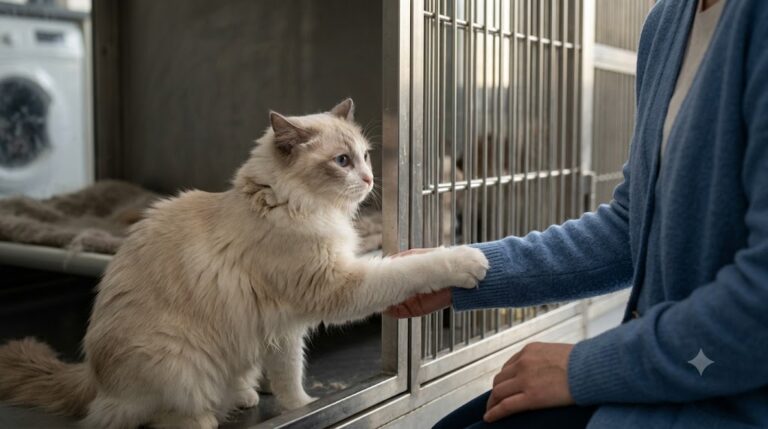
Luna was curled in her bed, her clean cream-colored fur resting against a soft grey blanket.
The room was quiet.
The hallway lamp cast a narrow strip of light across the floor.
After a while, Luna lifted her head, glanced toward the doorway, and stretched.
She walked to the edge of the light, sat for a moment, then returned to her blanket.
Within minutes, she was asleep again.
Emily watched the footage without speaking.
Luna’s past remained uncertain, and no one could promise that her fear would disappear completely.
But her foster caretaker had stopped trying to make her tolerate complete darkness.
Instead, she had changed the environment to help Luna feel more comfortable.
For weeks, Luna had treated every dark room like somewhere she needed to escape.
Now, one small hallway light was helping her spend the night without fear taking over.