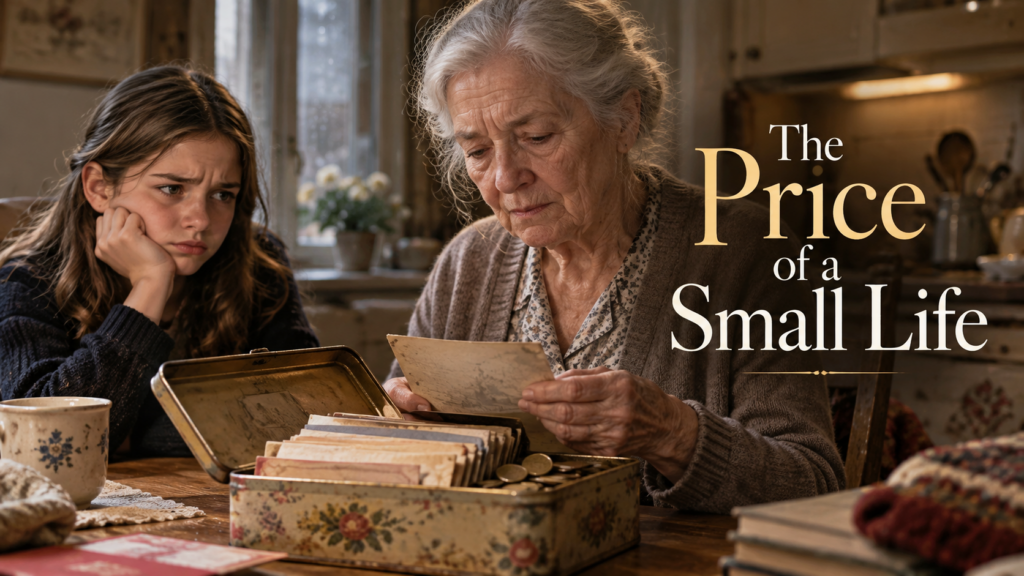
A novel about a grandmother, a granddaughter, and eighteen years of things left unsaid.
The first time Hannah Weiss called her grandmother cheap, she was eleven years old and standing in the kitchen with a birthday invitation in her hand.
It was a Saturday afternoon in late November. Outside the windows, the roofs of Graz were dark with rain, and water ran through the gutters of the old apartment building where Greta Weiss had lived for more than forty years. The kitchen smelled of boiled potatoes, fried onions, and the faint medicinal scent of the lavender soap Greta kept beside the sink.
Hannah had come directly from school with her mother, carrying the invitation in a bright pink envelope.
The party was scheduled for the following weekend. Her classmate, Emilia, was turning twelve and had invited eight girls to an indoor climbing centre before taking them to a restaurant.
Hannah had been talking about it since she arrived.
“And Emilia said her parents are paying for everything. We don’t even have to bring money.”
Greta was standing at the sink, rinsing a saucepan.
“That’s generous.”
“And everyone is getting her a proper present.”
“Well, I should hope so. It’s her birthday.”
Hannah placed the invitation on the table.
“I was thinking of getting her that perfume set from Müller.”
Greta glanced over her shoulder.
“How much?”
“Twenty-nine euros.”
Her grandmother stopped rinsing the saucepan.
“For perfume?”
“It’s not just perfume. There are three things in the box.”
“Three things that smell nice?”
Hannah sighed.
“Grandma.”
“What?”
“Everyone’s buying her something.”
“Then she’ll have plenty of presents.”
“That isn’t the point.”
Greta shut off the tap and placed the saucepan upside down on a drying cloth.
“Twenty-nine euros is a lot of money for a child who already has everything she needs.”
Hannah crossed her arms.
“Emilia doesn’t have everything.”
“Does she have a roof?”
“Yes.”
“Food?”
“Obviously.”
“Parents who love her?”
“Grandma, stop.”
Greta dried her hands.
“Then perhaps you could make her something. You’re good at drawing.”
Hannah stared at her.
“Nobody makes presents anymore.”
“I do.”
“Yes, and everybody knows.”
The words came out sharper than Hannah intended.
Her grandmother looked at her for a moment, then returned the towel to its hook.
“Well,” she said, “somebody has to keep the tradition alive.”
Hannah looked toward her mother, who was sitting at the other end of the table sorting receipts from her handbag.
“Mum, please.”
Claudia Weiss sighed.
“We’ll talk about it when we get home.”
“But I need to buy it tomorrow.”
“Hannah.”
Hannah pushed back her chair.
She was wearing new black ankle boots her mother had bought after weeks of negotiations. Greta had already examined them twice, asking whether they were waterproof and whether the soles could be repaired.
Hannah had told her that people did not repair shoes anymore.
Greta had replied that cobblers might be surprised to hear it.
Now, as Hannah walked toward the hallway, she heard her grandmother call after her.
“Don’t leave that light on.”
Hannah turned.
“What?”
“The bathroom light. You left it on.”
“I was coming back.”
“You weren’t in the bathroom.”
“It’s one light!”
Greta came into the doorway.
“And the switch works perfectly well.”
Hannah stared at her.
For months, the little rules had been accumulating inside her: the lights, the water, the leftover bread, the old newspapers tied with string, the envelopes reused until they looked like patchwork, the birthday presents that came wrapped in brown paper.
She was tired of being told to think about money.
She was tired of knowing that other children received expensive gifts from their grandparents while she received knitted socks, secondhand books, or pencil cases Greta had sewn from scraps of fabric.
Most of all, she was tired of being made to feel guilty for wanting ordinary things.
“Why are you so cheap?”
The kitchen became quiet.
Claudia looked up.
“Hannah.”
But the girl was already speaking.
“You complain about everything. Water, electricity, food. You act like spending five euros is a crime.”
Greta stood beside the bathroom door.
Her silver hair was pinned into its usual loose knot. The sleeves of her pale grey cardigan were rolled to her elbows, exposing thin wrists and hands marked by age and years of work.
She did not raise her voice.
“Money is difficult to earn.”
“I know that.”
“Then you should understand why we don’t waste it.”
Hannah looked at her.
“I understand why you don’t. I just don’t understand why you make everyone else miserable about it.”
Greta said nothing.
Claudia stood.
“Apologise.”
Hannah looked at her mother.
“But-“
“Now.”
Hannah swallowed.
“Sorry.”
The word came out so reluctantly that it barely qualified as an apology.
Greta nodded once.
“All right.”
She returned to the kitchen.
Claudia took her daughter’s coat from the hook.
“We’re going home.”
Hannah followed without speaking.
As they walked downstairs, she heard the old kitchen tap running again.
She imagined Greta washing the dishes in a shallow basin of water instead of leaving the tap open, counting every drop as if the water company might send a personal letter of thanks.
She rolled her eyes.
It would be years before she remembered that afternoon with anything resembling shame.
At eleven, she simply thought her grandmother was the most unreasonable woman in Austria.
Greta Weiss had never considered herself unreasonable.
She considered herself careful.
There was a difference.
She had been born in 1944, during the final year of the war, into a family whose financial difficulties continued long after the fighting ended.
Her father had worked irregular jobs in the years following the war. Her mother cleaned offices and took in mending from neighbours.
The family had lived in two cramped rooms on the outskirts of Graz, where winter coats were handed down until the cuffs wore through and nothing edible was thrown away.











