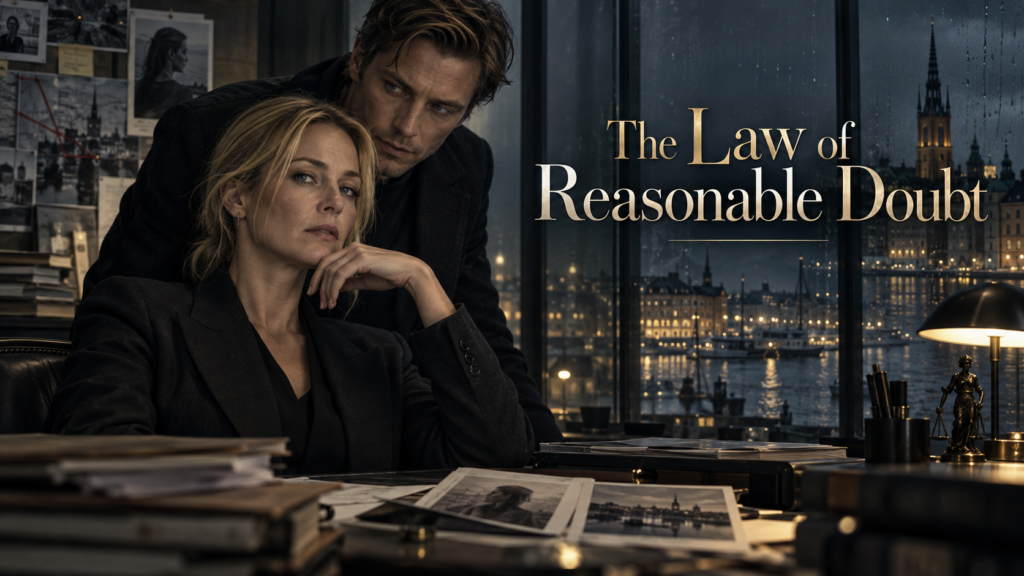
Part One: The Things We Believe
Stockholm, Sweden – November
The first lie Helena Falk told about the Lindholm case was not to a judge, a police officer, or the man accused of killing his wife.
It was to her daughter.
She told Sofia she would be home for dinner.
At six forty-five that evening, Helena was still sitting in her office on the seventh floor of a building overlooking Stockholm’s waterfront, reading a postmortem report that described the injuries of a woman she had never met.
Outside, the November darkness had arrived early. Rain moved across the windows in long diagonal streaks, blurring the lights along Strandvägen into pale yellow smudges. A ferry was crossing the harbour, its deck lights trembling on the black water.
Helena had promised Sofia they would make mushroom risotto together.
She had even bought the mushrooms.
They were downstairs in the staff refrigerator, wrapped in brown paper beside a container of milk someone had forgotten to label.
Her phone vibrated.
Are you coming?
She glanced at the message, then returned to the photograph on her desk.
The dead woman lay on a white examination table beneath clinical lighting. Her dark hair had been drawn away from her face. A narrow bruise ran along the side of her neck. There were smaller marks on one wrist and a crescent-shaped abrasion near her jaw.
The report listed the probable cause of death as compression of the neck.
Helena enlarged one of the photographs.
The bruising was uneven.
That interested her.
At forty-three, Helena Falk had spent almost eleven years defending people accused of serious crimes. She had learned to distrust the apparent simplicity of photographs. A bruise could demonstrate contact, but rarely intention. A fingerprint could place someone in a room without establishing what had happened there. Witnesses could be sincere and mistaken at the same time.
She had built her career on the distinction between what could be shown and what people wanted to believe.
Her colleagues sometimes joked that she could create doubt about the color of a clear summer sky.
The joke was affectionate when she won.
Less so when she lost.
She opened the accompanying investigative summary.
Victim: Annika Lindholm, 38.
Suspect: Matthias Lindholm, 42.
Relationship: Married, eleven years.
Location of death: Private residence, Djurgården, Stockholm.
Helena studied the timeline.
The couple had attended a charity dinner at a hotel in central Stockholm. They returned home shortly after eleven. At 12:18 a.m., an emergency call was placed from Matthias Lindholm’s phone.
Paramedics arrived to find Annika unconscious on the bedroom floor.
Matthias was kneeling beside her.
He told the first responding officer that his wife had fallen and struck her head.
The medical findings did not support that explanation.
Two days later, he was arrested.
The case had already attracted considerable attention.
Matthias Lindholm was a Swedish-German technology investor whose companies managed logistics software used across northern Europe. Annika had been an architect and a prominent patron of arts education. Their marriage appeared frequently in society pages, though friends described it as increasingly strained.
The newspapers preferred a simpler story.
Wealthy husband.
Beautiful wife.
Unhappy marriage.
Violent argument.
Death.
Helena knew how easily a jury could be persuaded by a sequence that felt inevitable even when crucial pieces were missing.
Her phone vibrated again.
Mom?
Helena closed the photographs.
I’m sorry. Emergency at work. Order something good. I’ll make it up to you.
The message remained unanswered for several minutes.
Then Sofia replied.
You always say that.
Helena stared at the screen.
She could have called.
She could have gone home.
Instead, she turned back to the investigative report.
Helena lived in a pale brick apartment building in Östermalm with her sixteen-year-old daughter and a collection of houseplants she routinely forgot to water.
Her marriage had ended seven years earlier.
Her former husband, Anders Nyström, was a physician who had eventually grown tired of living according to court schedules and the unpredictable demands of other people’s disasters.
Their divorce was not acrimonious.
That made it strangely difficult.
Anders had not been cruel. He had not been unfaithful. He had simply reached a point where he no longer believed the marriage could accommodate both their lives.
Helena had argued against the separation as though presenting a case.
She explained the importance of commitment.
The temporary nature of professional pressure.
The practical difficulties of maintaining two households.
Anders listened.
Then told her that he did not want to spend the rest of his life being persuaded to remain somewhere he was unhappy.
She remembered that sentence with particular clarity.
It was the first time she understood that winning an argument could leave the underlying problem entirely unchanged.
Sofia split her time between both parents.
She was clever, reserved, and already suspicious of adults who described neglect as sacrifice.
Her father attended school performances and parent meetings with the quiet dependability Helena had once considered insufficiently ambitious.
Helena attended when she could.
When she couldn’t, she sent flowers, money, apologies, or promises.
She loved her daughter fiercely.
She was not always good at making that love visible.
On the morning after she received the Lindholm file, Helena found Sofia eating breakfast alone.











