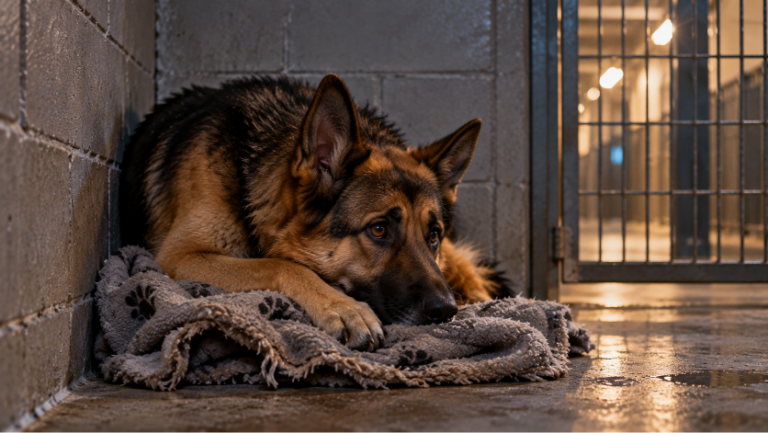
Investigators could not determine every detail of Hank’s experience. But one part of the scene stood out to shelter staff.
Photographs from the property showed a patch of flattened dirt beside the water pan, as though a dog had repeatedly lain or stood there for long periods.
A veterinary behaviour consultant reviewing Hank’s case suggested that the dog may have developed a strong association between water and survival during a period of chronic deprivation and heat stress.
For Hank, staying close to the water may have become more important than resting comfortably.
Even after rescue, even after regular access to clean water was guaranteed, the old behaviour remained.
What looked like an odd sleeping habit may have been a learned survival response.
Once staff understood that possibility, they changed their approach.
Rather than repeatedly pulling Hank away as soon as he approached the bowl, they began working to help him feel safe resting nearby without needing to stand over it.
They placed a second bed beside the water area. Then they added a raised rubber mat so he could lie near the bowl more comfortably. Caretakers also began offering water on a predictable schedule throughout the day and quietly sitting nearby in the evening without interrupting him.
The goal was not to force the behaviour to disappear overnight.
It was to show Hank, through repetition, that the water would still be there when he woke up.
Progress came slowly.
At first, Hank continued standing over the bowl until he nearly nodded off. But after several days, staff observed him lowering his body onto the mat beside it. He still kept his head close to the rim, and he often woke suddenly to check the water, but he was no longer fighting sleep quite so hard.
Then, one evening, Lauren watched him approach the bowl as usual.
He drank for a few seconds.
He paused, staring into the water.
His head sagged once, then lifted again.
Instead of remaining upright, Hank stepped sideways and lay down on the mat beside the bowl, resting one paw against its base.
“He wanted to stay near it,” Lauren said. “But for the first time, he let himself sleep.”
By the end of the week, Hank was alternating between the bed and the mat near the bowl. Shelter staff considered it a meaningful change, even if his habit had not disappeared entirely.
His rehabilitation remains ongoing, and no one can know with certainty exactly what Hank experienced before his rescue.
But staff believe his behaviour tells part of the story.
Some dogs are afraid of hands. Some are afraid of doors, darkness, or sudden sounds.
Hank seems to be afraid of falling asleep too far away from the one thing he may once have needed most.