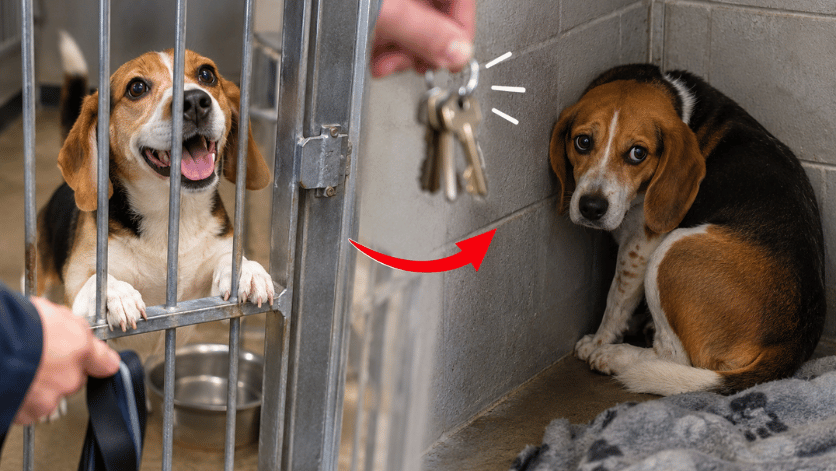
ASHEVILLE, NORTH CAROLINA – Every morning, a rescued Beagle named Finn races toward his kennel door as soon as he sees his favourite caretaker approaching. He jumps excitedly, wags his tail, and presses his nose against the metal bars.
But the moment he hears a set of keys jingling, everything changes.
His tail drops between his legs.
His body stiffens.
And within seconds, the once-excited dog retreats into the farthest corner of his kennel, trembling as he watches the caretaker’s hands.
The four-year-old Beagle has been living at a local animal shelter for nearly seven weeks. Although he enjoys outdoor walks and responds affectionately to familiar volunteers, his reaction to jingling keys has become one of the most troubling behaviours staff have observed.
“He’s perfectly happy until he hears that sound,” said shelter volunteer Claire Bennett. “Then it’s like we’re looking at a completely different dog.”
The behaviour first became apparent during Finn’s second week at the shelter.
Claire had approached his kennel carrying a leash and a small ring of keys.
Finn rushed forward, jumping against the gate.
But when Claire reached for the lock, the keys clattered together.
Finn immediately dropped onto his stomach.
His ears flattened, his tail tucked tightly beneath him, and he scrambled backwards until his body pressed against the wall.
Claire opened the kennel door.
Finn refused to move.
When she stepped inside, he began trembling harder.
She stopped and slowly backed away.
For nearly fifteen minutes, Finn remained in the corner.
At first, staff suspected he was frightened of the kennel door opening.
However, observations over the following days suggested something different.
When caretakers approached without carrying keys, Finn often greeted them normally.
He willingly followed them through open doorways.
He even walked past unlocked metal gates without hesitation.
But the sharp metallic sound of keys striking one another repeatedly triggered the same response.
Staff began reviewing his rescue history.
Finn had been recovered from a rural property outside Asheville after an animal welfare investigation into the conditions in which several hunting dogs were being kept.
Officers found him inside a small wooden enclosure behind an unused equipment shed.
At the time of his rescue, Finn was noticeably underweight.
His tricolour coat was filthy, with dried mud across his legs, patches of irritated skin beneath his collar, and several small, healed scars near his shoulders.
His bedding was damp, and the enclosure’s wooden floor was stained.
Veterinary staff treated his skin irritation and provided nutritional support.
Within weeks, Finn had gained weight, and his coat had become healthier.
But his fear of the keys remained.
The explanation began to emerge when investigators reviewed statements collected from people familiar with the property.
A former employee described how the dogs had been kept inside separate wooden pens secured with heavy metal locks.
The owner carried a large ring of keys attached to his belt.
According to the employee, the sound of those keys often preceded the dogs being removed from their enclosures for handling and training.
Some of those sessions involved harsh leash corrections and physical restraint.
The employee recalled seeing Finn resist leaving his pen on several occasions.
When he refused, he was reportedly pulled forward by his collar.
Investigators could not determine precisely how often Finn had experienced these interactions.
However, the witness’s account offered a possible explanation for his unusual fear.
The sound of keys may have become associated with being taken from his enclosure for experiences he found frightening or painful.
At the shelter, that same sound now came before something he genuinely enjoyed.
A walk.
Fresh air.
Time outdoors.
But Finn’s reaction suggested that the positive experience awaiting him had not yet replaced his previous association with the sound.
Staff decided to change his daily routine.
Instead of approaching with a jangling key ring, caretakers began carrying a single key secured in a soft fabric pouch.
They avoided unnecessary metallic noises near his kennel.
Claire also stopped reaching toward the lock while Finn was displaying signs of fear.
If he retreated, she waited.
If he remained in the corner, she allowed him to stay there.
During later training sessions, a behaviour specialist introduced very faint recordings of jingling keys from a comfortable distance, pairing the sounds with positive experiences only when Finn remained relaxed.
His progress was gradual.
Some mornings, he approached the gate immediately.
Other mornings, an unexpected metallic noise still sent him backwards.
Then, one December afternoon, Claire arrived for his usual walk.
Finn ran toward her, wagging enthusiastically.
She carefully removed the padded key pouch from her pocket.
A faint metallic click escaped as she opened it.
Finn froze.
His tail lowered, and he took two steps backwards.
Claire immediately stopped.
She crouched beside the kennel without approaching him.
“That’s okay, Finn. Take your time.”
For nearly a minute, Finn watched her.
Then he slowly stepped forward.
He sniffed her hand.
Claire remained still.
After another moment, Finn approached the gate and waited while she quietly unlocked it.
When the door opened, he hesitated briefly before walking out beside her.
Outside, Finn lowered his nose to the grass and began sniffing along the familiar path.
His tail gradually lifted.
Claire followed at his pace.
Finn still reacted fearfully to sudden jingling noises, and shelter staff knew his recovery would require continued patience.
But they had learned that forcing him through his fear wasn’t necessary.
For Finn, the sound of keys had once meant that something frightening might happen next.
Now, the people caring for him were making sure he had time to discover that an opening door could lead somewhere safe.