ANCHORAGE, ALASKA – An Alaska Malamute stranded on a breaking sheet of river ice during a violent overnight snowstorm survived a dangerous rescue after emergency crews reached him moments before the freezing current swept him downstream.
The dramatic incident began shortly after 11 p.m., when a passing motorist reported hearing repeated howls near a partially frozen river outside Anchorage.
Temperatures had fallen well below freezing, and strong winds were pushing heavy snow across the surrounding roads.
At first, the motorist could not see anything through the darkness.
Then a flashlight beam caught movement near the middle of the river.
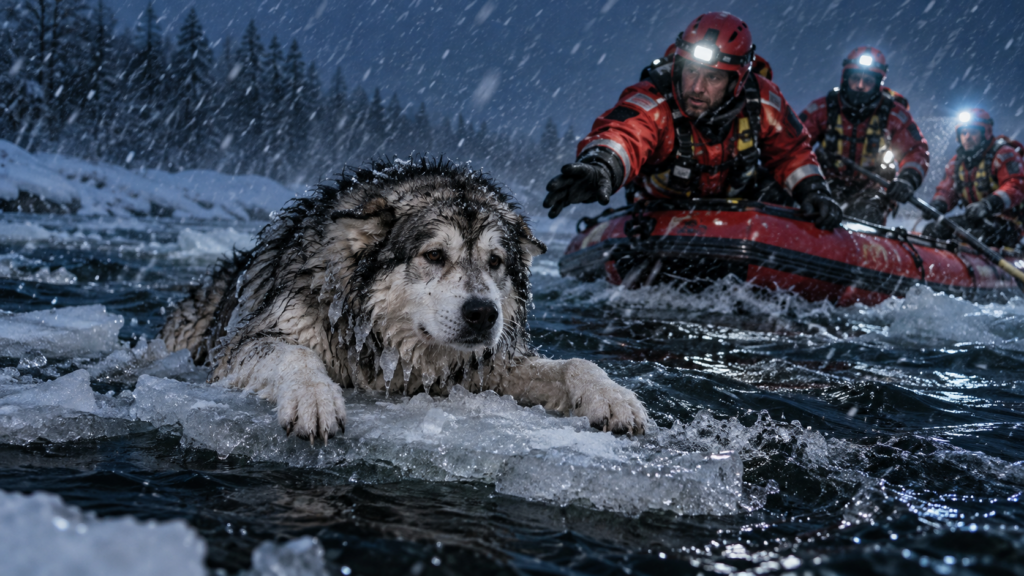
A large gray-and-white dog was clinging to a small, unstable sheet of ice surrounded by fast-moving black water.
He was later identified as Leo, a four-year-old Alaskan Malamute that had escaped from a nearby property earlier that evening.
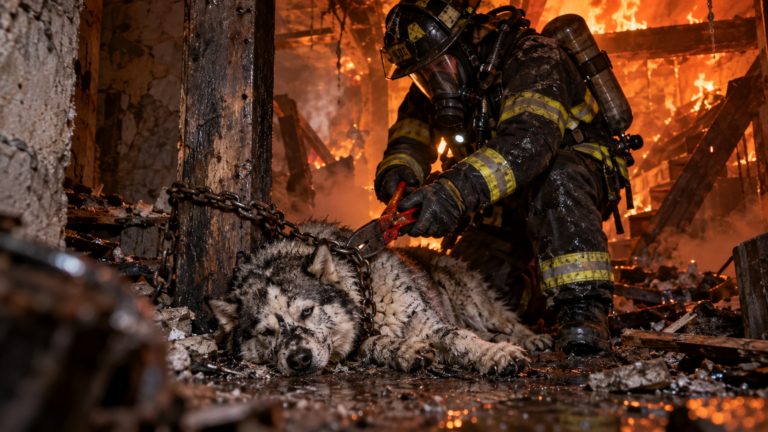
His thick double coat was completely soaked. Ice had formed around his chest, belly, and legs, while clumps of wet fur hung from his neck.
Leo repeatedly tried to pull himself farther onto the ice.
But every movement caused the frozen surface to shift beneath him.
The motorist immediately contacted emergency services.
When a specialist water rescue team arrived, Leo was still stranded approximately thirty metres from the riverbank.
His front paws were pressed against the ice, while much of his lower body remained submerged.
The current pulled continuously against his hind legs.
Every few minutes, he lifted his head and released a weak, exhausted howl.
Rescue coordinator Mark Sullivan assessed the conditions from shore.
The river was carrying broken ice downstream, making a conventional rescue boat too vulnerable to damage.
The team prepared aspecialisedd inflatable rescue craft designed for cold-water operations.
Rescuers wore insulated immersion suits, helmets, flotation equipment, and safety harnesses.
A shore crew maintained rescue lines while the inflatable craft moved cautiously between floating sheets of ice.
But reaching Leo was proving difficult.
The current repeatedly pushed the boat away from the narrow channel leading toward the dog.
Meanwhile, the sheet of ice beneath Leo continued breaking apart.
One corner snapped off and drifted downstream.
Leo shifted his weight, desperately trying to maintain his balance.
His front paws slipped.
He struggled to pull himself higher.
Then he stopped moving.
His head lowered until his muzzle nearly touched the freezing water.
From the rescue boat, Mark could see that the dog was becoming dangerously exhausted.
“We need to get to him now.”
The crew repositioned the craft, using the current to approach from a safer angle.
They were still several feet away when a loud cracking sound echoed across the river.
The ice beneath Leo split.
His front paws slid apart.
And the large Malamute suddenly dropped into the dark water.
For a moment, only his head remained visible.
He paddled weakly, struggling against the current.
Then a wave pushed him beneath the surface.
Mark, secured to the rescue craft by specialist safety equipment, entered the water from the controlled rescue position.
His teammate maintained the safety line.
As Leo resurfaced beside the boat, Mark reached toward him.
He caught the dog’s harness and supported his head above the water.
The current pulled against both of them.
Working together, the rescuers manoeuvred Leo toward the inflatable craft and lifted his heavy, waterlogged body aboard using a rescue sling.
The exhausted dog collapsed onto the floor of the boat.
His chest moved rapidly.
His ears hung low, and his soaked fur clung tightly to his body.
Mark placed a gloved hand against his shoulder.
“Stay with us, buddy. We’ve got you.”
The team immediately returned to shore.
Leo was transferred to a sheltered emergency treatment area, where responders began carefully managing his dangerously low body temperature.
His wet coat was gently dried, and he was wrapped in insulating blankets while emergency veterinary transport was arranged.
At the veterinary hospital, Leo received controlled warming, intravenous fluids, and continuous monitoring.
Veterinarians confirmed that he had suffered significant hypothermia and severe exhaustion.
His paws also showed mild cold-related irritation, but no major fractures or other traumatic injuries were identified.
For the first twenty-four hours, staff remained concerned about possible complications from cold-water immersion.
Leo slept for much of the night.
Occasionally, he opened his tired brown eyes when a nurse adjusted his blankets.
By the following afternoon, his temperature had stabilised.
He was drinking water, showing interest in food, and responding more readily to familiar voices.
His owner, 46-year-old Daniel Foster, arrived at the hospital after being contacted by animal control.
Daniel explained that Leo had escaped through a damaged section of backyard fencing during the storm.
He had spent hours searching nearby streets before learning about the river rescue.
When Daniel entered the recovery room, Leo lifted his head.
His tail moved slowly against the blanket.
Daniel knelt beside him.
“I’m so sorry, boy.”
Leo leaned forward and pressed his wet nose against his owner’s hand.
Over the following weeks, Leo continued recovering.
His thick gray-and-white coat gradually returned to its normal condition, his paws healed, and his strength improved.
Three months later, Mark visited Leo at his home outside Anchorage.
The yard was covered in fresh snow.
Leo was standing near the porch when Daniel opened the gate.
The Malamute noticed the visitor and immediately trotted across the yard.
Mark crouched.
“Hey, Leo. Remember me?”
Leo approached enthusiastically, sniffed his gloves, and leaned his large body against him.
Mark laughed and gently scratched behind his ears.
The dog wagged his tail and bounced playfully through the snow before returning for another greeting.
Three months earlier, Leo had been unable to keep himself above the freezing river.
Now, he could run freely across the snow-covered yard.
Daniel watched from the porch as Leo settled beside Mark, pressing his broad head against the rescuer’s knee.
On the night of the storm, Leo had been surrounded by ice, with nowhere safe to stand.
Now, he was surrounded by snow, with a warm home waiting just a few steps away.