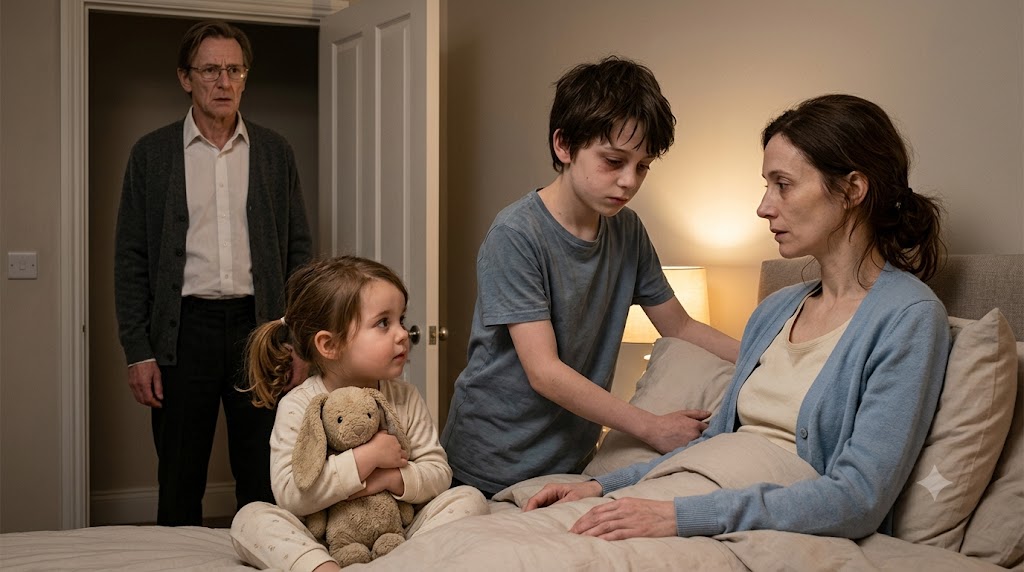
The first time Mr Vance called Lucas Bennett lazy, the boy was too tired to defend himself. It was a Tuesday morning in late November, and the heating system at Westbridge Academy had been running since half past six. Warm air circulated through the mathematics classroom, carrying the faint smell of old books, damp wool coats, and the coffee that MMrVance kept in a steel travel mug beside his desk. Outside, a miserable London rain pressed against the windows. Inside, twenty-eight students were working through a set of algebra problems while their teacher moved between the rows, checking answers and correcting mistakes with the impatience of a man who believed that every error could be prevented by sufficient effort. Lucas sat near the back, his school jumper slightly too large around the shoulders and the sleeves pulled over his hands. His pencil was still touching the paper when his eyes closed. He had been awake for almost twenty-six hours, apart from seven minutes of sleep on the upper deck of a bus that morning, but there was nothing in his appearance to distinguish exhaustion from indifference. His hair was untidy, his face pale, and the dark circles beneath his eyes had become so permanent that even he no longer noticed them. When his head finally dropped forward, the sound of his forehead striking the desk brought several students’ attention away from their work.
“Mr Bennett.” MMrVance’s voice cut across the classroom. Lucas did not immediately respond. The teacher stopped beside his desk and struck the wooden surface twice with the flat of his hand. “Lucas. Since you’ve apparently decided that my lesson is an appropriate place for a nap, perhaps you’d like to explain the solution to question seven.” Lucas lifted his head. For a second, he looked around without understanding where he was. A few students laughed, and someone near the windows muttered that he was probably gaming until four in the morning again. Lucas heard the comment, but he was still struggling to make the numbers on the whiteboard settle into recognisable shapes. Mr Vance waited, his arms folded, until the silence became uncomfortable. “I asked you a question.” Lucas swallowed and looked down at his exercise book. His handwriting began neatly at the top of the page, deteriorated halfway through the second problem, and ended in a line of pencil that had wandered off the margin. “I’m sorry, sir,” he said. “I was trying to finish it.” MMrVance gave a short, humourless laugh. “Trying? You’ve been trying for three weeks, Bennett. Everyone else seems capable of remaining conscious for fifty minutes. Is that an unreasonable expectation?” Lucas lowered his eyes. He could have explained that he had spent the previous night cleaning industrial baking trays, carrying sacks of flour, and scrubbing the tiled floor of a commercial kitchen until his hands hurt. He could have said that he’d gone home afterwards to check whether his mother’s medication had been delivered before helping his little sister dress for nursery. But he could already imagine the questions that would follow, and he had no confidence that answering them would improve anything. “No, sir,” he replied. “Then sit up. If you’re old enough to stay awake all night, you’re old enough to accept the consequences the next morning.”
By December, the incident had become a familiar part of Mr Vance’s lessons. Sometimes Lucas was ordered to stand beside his desk for ten minutes. Sometimes he was given detention, which he could rarely attend because he needed to collect his sister from her childminder. When he failed to appear, another sanction was recorded. He accumulated warnings for unfinished homework, lateness, inappropriate uniform, and repeated sleeping in class. On one occasion, Mr Vance confiscated his phone after seeing him check it beneath the table. Lucas tried to explain that he was waiting for an important message, but the teacher had already placed the device in his drawer. It remained there until the end of the school day. When Lucas retrieved it, he discovered three missed calls from his mother’s community nursing team and a message from the neighbour who sometimes helped look after his sister. Nothing catastrophic had happened, but the experience frightened him enough that he began keeping the phone inside his sock during lessons, where he could feel it vibrate against his ankle without taking it out.
Mr Vance interpreted the change as another attempt to evade classroom rules. He had taught mathematics for twenty-four years and had developed a reputation for being demanding, organised and almost impossible to deceive. Parents who wanted their children pushed toward top universities requested places in his advanced classes. His examination results were consistently among the strongest in the borough. He remembered former pupils who had become engineers, accountants, architects, and doctors, and he occasionally used their achievements as examples when criticising students he considered unmotivated. His colleagues respected his subject knowledge, although several privately disliked the way he addressed weaker pupils. He was not a man who shouted constantly. His disapproval was usually quieter and more precise. He had a talent for making a student feel that a mistake in one exercise revealed a permanent defect of character. He genuinely believed that holding teenagers to high standards was a form of respect. What he seldom considered was the possibility that a student’s failure to meet those standards might be caused by something other than a failure of will.
Lucas had not always been a difficult student. In Year 10, he had earned excellent marks in mathematics and physics, and his teachers had described him as capable, careful, and unusually persistent with difficult problems. He enjoyed understanding how things worked. When an equation confused him, he would stay behind after class to work through it until he could explain every step. His mother used to joke that he could calculate the electricity bill faster than the supplier could send it. At fourteen, he built a working model of a lift using parts salvaged from a broken printer and spent an entire Saturday adjusting the mechanism so that it stopped accurately at each floor. He once told a careers adviser that he wanted to study mechanical engineering, preferably somewhere that would allow him to work on trains or aircraft. The adviser had smiled and encouraged him to consider university entrance requirements. At that time, Lucas’s future had seemed like something that could be improved through hard work. He had not yet discovered that hard work could also consume the hours a person needed to remain healthy.











