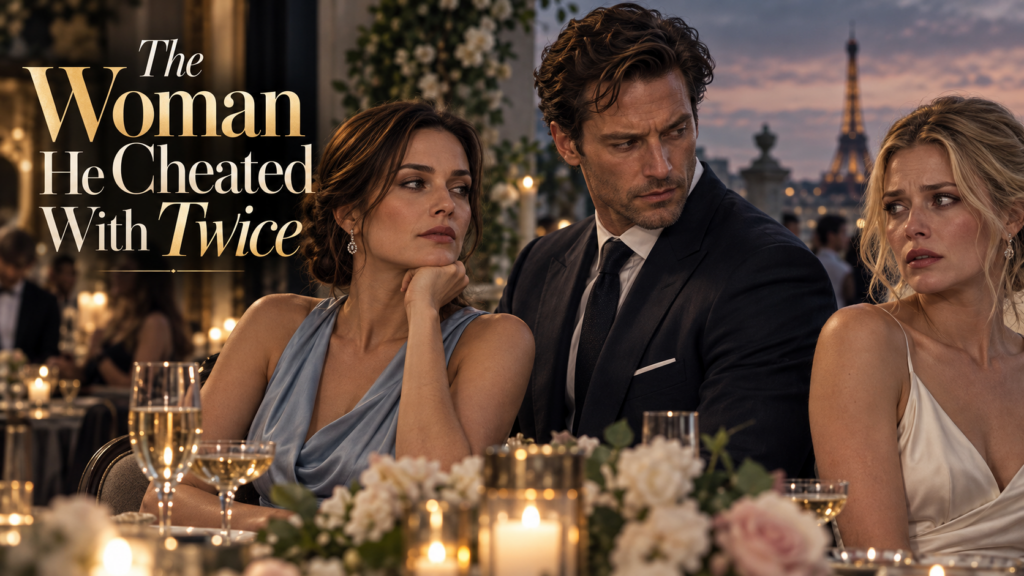
He left his wife for another woman. Three years later, that same woman discovered her husband’s mistress was the wife he’d abandoned.
The first time Vivienne Laurent met her husband’s future mistress, the woman complimented her wedding ring.
It happened at a garden party outside Paris, beneath an enormous white canopy where wealthy people drank champagne and discussed charity with the self-congratulatory seriousness usually reserved for matters of national importance.
Vivienne was thirty-two that summer. She wore a pale blue silk dress, her chestnut hair gathered loosely at the nape of her neck, and a wedding ring that had belonged to her grandmother. The ring was a narrow platinum band, modest except for a tiny emerald set on the inside.
Her husband, Gabriel Laurent, had given it to her at a small wedding in Provence six years earlier.
He had slipped it onto her finger with shaking hands.
At the time, she thought the trembling meant love.
Now, standing beside the rose garden at the Beaumont estate, she watched a beautiful young woman turn the ring gently between two fingers.
“It’s lovely,” the woman said. “So understated.”
Vivienne smiled.
“It was my grandmother’s.”
“How romantic.”
The young woman released her hand.
She was tall and slender, with long honey-blond hair, striking blue eyes, and the kind of flawless complexion that suggested either fortunate genetics or an excellent dermatologist. Her white summer dress was elegant without appearing particularly expensive.
“I’m Camille Beaumont,” she said.
“Vivienne Laurent.”
Recognition brightened Camille’s face.
“Gabriel’s wife?”
“That’s right.”
Camille smiled more warmly.
“I’ve heard so much about you.”
Vivienne laughed.
“Hopefully nothing too terrible.”
“Only that you’re brilliant.”
Before Vivienne could answer, a familiar voice came from behind her.
“Camille.”
Gabriel approached carrying two glasses of champagne.
He was thirty-six, with dark hair, strong features, and a smile that had once made Vivienne forget the end of her own sentences. He wore a navy linen jacket and moved through expensive gatherings with practised ease, pausing when necessary to acknowledge a face or shake a hand.
His family had once owned a modest printing business near Lyon.
Gabriel preferred not to discuss that.
He described himself as a producer, an entrepreneur, and occasionally a visionary, depending on whom he was trying to impress.
Over the years, Vivienne had learned that his actual profession involved persuading people with money to finance creative projects they might otherwise consider unreasonable.
He was good at it.
Exceptionally good.
But he had not been born into the world he now moved through.
He still watched rich men carefully, as though studying a language he wanted to speak without an accent.
Gabriel handed Vivienne a glass.
Then looked at Camille.
“I see you’ve met.”
“Your wife is charming,” Camille said.
Gabriel’s smile lingered.
“She usually is.”
Vivienne looked from one to the other.
Something passed between them.
It was so small that she almost missed it.
Camille’s gaze fell briefly toward Gabriel’s left hand.
Gabriel adjusted his cuff.
Then they looked away from each other.
Vivienne would remember the exchange years later.
At the time, she thought Camille was simply shy.
That was how betrayal entered her marriage.
Not through a confession.
Not through an unmistakable touch.
Through a moment too small to justify asking a question.
Vivienne had met Gabriel in a crowded café near the Sorbonne.
She was twenty-five, working for a Parisian art-restoration foundation after completing postgraduate studies in cultural heritage management.
Gabriel was twenty-nine and attempting to finance his first independent documentary.
He approached her table because every other chair was occupied.
“May I?”
Vivienne looked up from a stack of reports.
“If you don’t mind the paperwork.”
He sat.
Within minutes, he’d made a joke about how much documentation the French required to restore a building that had survived two centuries without permission.
She laughed.
He asked what she was working on.
She explained.
He listened with an attentiveness that made her feel interesting rather than merely attractive.
When he described the documentary, she asked about the budget.
He looked surprised.
“Most people ask what it’s about.”
“I assume you already know what it’s about.”
He grinned.
“And you want to know whether I can afford to make it.”
“Precisely.”
He pulled a notebook from his bag.
They spent the next forty minutes discussing financing, locations, and a projected production schedule that Vivienne thought was dangerously optimistic.
At the end, Gabriel looked at her with open admiration.
“You’ve just dismantled six months of my planning.”
“Only the parts that wouldn’t work.”
“Would you have dinner with me?”
She smiled.
“Is that your usual response to criticism?”
“Only when it’s intelligent.”
They married eighteen months later.
In the beginning, their marriage felt like an alliance.
Vivienne had practical knowledge, discipline, and a talent for negotiation.
Gabriel had imagination, charisma, and the ability to persuade other people to believe in a project before it existed.
Together, they made things happen.
She helped him prepare financing proposals.
He encouraged her to leave the foundation and establish a consultancy advising private collectors and cultural institutions on restoration projects.
They rented a small apartment in the eleventh arrondissement.
They worked late.
Ate dinner sitting on the floor.
Fought about money.
Made up over breakfast.
When Gabriel secured financing for his first substantial production, he brought home a bottle of champagne so cheap that Vivienne suspected it had been purchased from the petrol station.
They drank it from mismatched coffee mugs.
He kissed her forehead and said, “When I’m successful, I’ll buy you the finest champagne in France.”
Vivienne laughed.
“I’d prefer a dishwasher.”
He promised both.
Years later, they owned a spacious apartment near Parc Monceau, an apartment in Nice they rarely used, and a dishwasher that operated so quietly it was sometimes difficult to tell whether it was running.
They also owned far more expensive champagne than either of them enjoyed drinking.
Vivienne missed the coffee mugs.
Success arrived gradually, then all at once.
Gabriel’s production company, Laurent Pictures, developed a reputation for sophisticated European documentaries and prestige television projects.
Several productions received international distribution.
He began meeting investors in London, Berlin, and Geneva.
He bought beautifully tailored suits.
Changed his watch.
Stopped answering calls from certain old friends because, he explained, he no longer had time for people who expected things from him.
Vivienne noticed.
She also noticed that he still turned to her whenever a difficult contract needed reading or a financier required reassurance.
She had become successful herself.
Her consultancy was respected among private museums and conservation trusts. She helped wealthy owners restore historic estates without destroying their character. She knew how to negotiate with architects, insurers, preservation authorities, and families who had inherited buildings they couldn’t afford to maintain.
Her work was demanding and often invisible.
She liked it.
Gabriel liked being married to someone admired for her intelligence.











