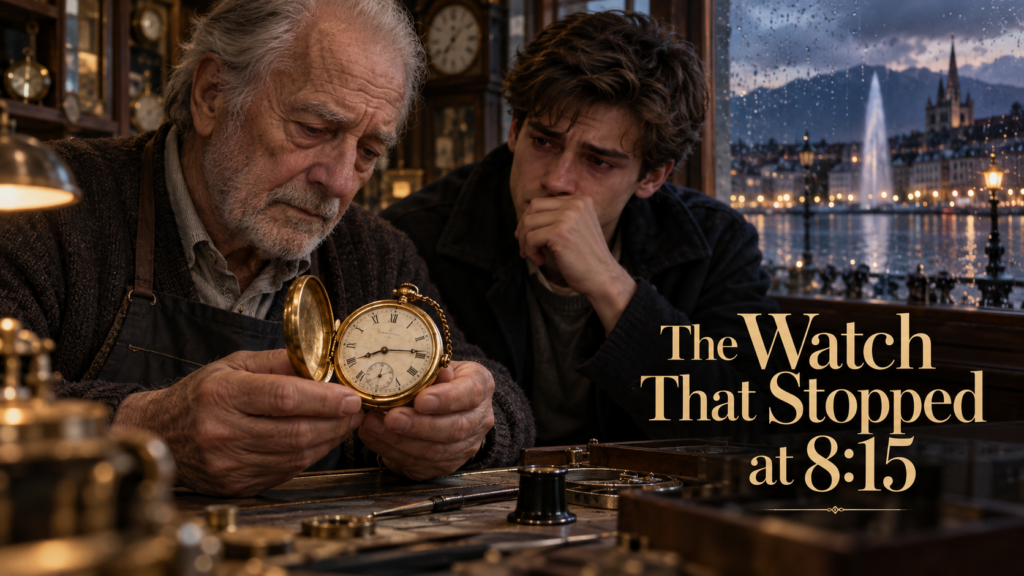
A story about a grandfather, a grandson, and the last thing a mother left behind.
Every morning at six forty-five, Henri Morel wound the clock above his kitchen door.
He had done so for thirty-eight years.
The clock was a modest French regulator with a walnut case and a brass pendulum. It had belonged to his father, who had bought it secondhand from a retired railway employee in Lausanne. Its dial had a small crack between the numerals four and five, and the minute hand had been repaired twice.
Henri could have replaced it with something more accurate.
He had no intention of doing so.
At seventy-six, he believed that replacing a functioning object merely because a newer one existed was a failure of imagination.
He believed the same about shoes, furniture, kitchen knives, and people.
The clock gained approximately forty seconds each week. Henri corrected it on Sunday mornings using the radio time signal, though he disliked how little attention modern broadcasters paid to the hour.
He lived above a watch repair shop in Geneva, on a narrow street not far from the Rhône. The shop had occupied the ground floor of the same stone building since 1979. Its green-painted sign read H. MOREL – HORLOGERIE & RÉPARATIONS.
In the front window stood a collection of clocks that nobody had offered to buy in years.
There was a carriage clock with a cracked porcelain dial, a brass travel alarm, and a grandfather clock too large for the window but displayed there anyway because Henri had never found a better place for it.
Customers came for different reasons.
Some brought valuable mechanical watches.
Others arrived with inexpensive clocks inherited from parents or grandparents and asked whether they were worth repairing.
Henri’s answer depended on what they meant by worth.
A repair that cost three hundred francs on an object with a resale value of fifty was unreasonable by ordinary commercial standards.
But Henri had once spent four days repairing a scratched watch belonging to an elderly widow because she wanted to hear it ticking beside her bed again.
He had charged her for the parts.
Nothing more.
His reputation for technical skill was excellent.
His reputation for friendliness was less impressive.
He disliked customers who insisted that their watches were completely original despite obvious replacement components.
He disliked collectors who cared more about auction prices than craftsmanship.
He disliked people who tapped on the counter while waiting.
He particularly disliked being told that nobody repaired things anymore.
“If that were true,” he would reply, “you wouldn’t be standing here.”
His daughter Élise had once told him that he could frighten customers without even looking at them.
Henri had considered this a useful professional skill.
Élise had laughed.
That memory came to him most often in the mornings, while the shop was still dark and the clocks had not yet begun to compete with the sounds of traffic outside.
It was one of the few memories of her that had never changed with time.
Her laugh had been quick, almost impatient, as if she could not bear to wait until someone finished saying something foolish.
Henri had not heard it in nineteen years.
Marc Laurent arrived on a Thursday in September with two suitcases, a backpack, and an expression that suggested he had already decided the arrangement would be intolerable.
He was nineteen, tall and narrow-shouldered, with dark, untidy hair, a faint scar through his left eyebrow, and headphones hanging around his neck.
His black jacket was damp from rain.
A silver chain disappeared beneath his shirt.
He stood in the entrance to the shop, studying the clocks.
“Doesn’t this place ever change?”
Henri was seated behind the counter, examining a watch movement through a loupe.
“Good afternoon to you too.”
Marc dropped his backpack.
“Hi, Grandpa.”
Henri removed the loupe.
“Your train was supposed to arrive at three.”
“It did.”
“It’s four twenty.”
“I got something to eat.”
“You could have telephoned.”
“My phone died.”
“You could have charged it.”
Marc looked at him.
“Good to see you too.”
Henri returned the loupe to its stand.
For a moment, neither moved.
Then Henri came around the counter.
He had become thinner over the previous year, although he would have denied it if anyone asked. His hair, once dark brown, was now entirely white. He wore the same charcoal waistcoat he had worn for years, with a watch chain crossing one pocket.
He looked at his grandson.
Marc was taller than he remembered.
That seemed to happen every time they met.
Henri held out his hand.
Marc hesitated, then shook it.
“Come upstairs,” Henri said. “I’ll show you the room.”
Marc picked up his suitcases.
“Same room as before?”
“Unless you want to sleep in the cellar.”
“Same room’s fine.”
Henri led the way.
The apartment smelled faintly of coffee, furniture polish, and the soup Henri had prepared that morning.
Marc remembered the narrow hallway, the framed photograph of the Alps, and the kitchen with its heavy wooden table.











