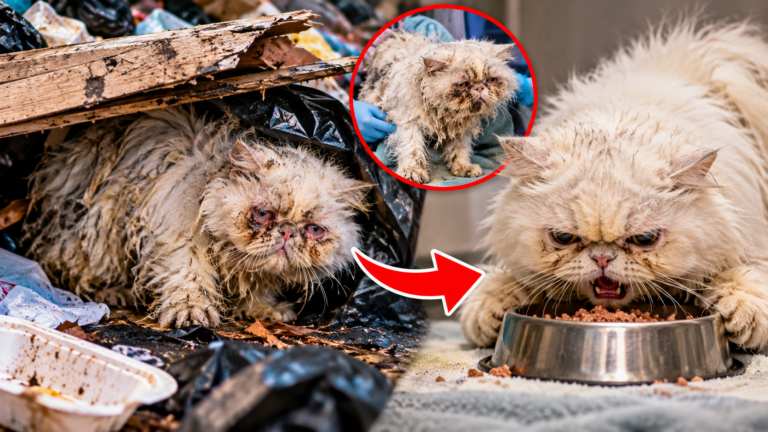
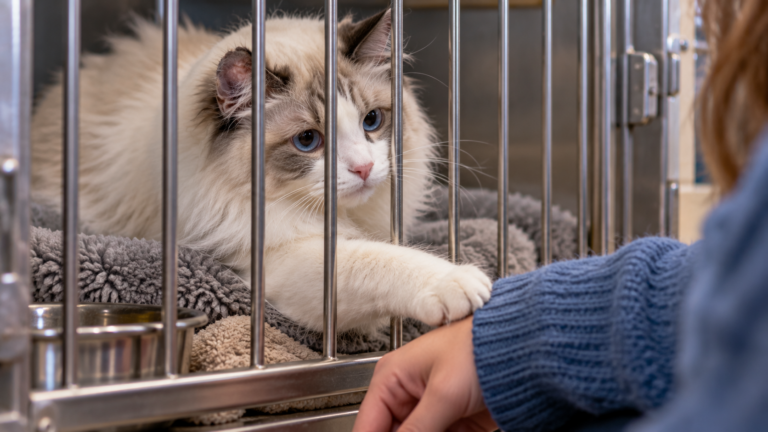
At the emergency animal hospital, veterinarians immediately identified signs of severe starvation and dehydration.
Blood tests showed significant liver abnormalities, and further examination raised strong concern for feline hepatic lipidosis, a dangerous condition associated with prolonged inadequate food intake.
Mika was also suffering from electrolyte disturbances and extreme muscle loss.
Her condition was critical.
The veterinary team began carefully planned fluid therapy, electrolyte correction, nutritional support, and close monitoring.
Because cats can develop serious metabolic complications when feeding is restarted after prolonged starvation, her nutritional rehabilitation had to be managed gradually.
Mika was too weak to eat enough by herself.
Veterinarians therefore used assisted nutritional support while monitoring her liver function and overall condition.
The first two days were especially difficult.
She spent most of her time lying on her side, barely responding when staff entered the room.
Occasionally, her eyes followed a moving hand.
Sometimes she lifted her head when a nurse spoke.
But even those small movements exhausted her.
On the third day, Mika managed to shift herself into a more upright resting position.
It took several attempts.
Her front legs trembled beneath her.
A veterinary nurse named Evelyn Brooks watched quietly as she struggled.
“That’s it, little girl.”
Mika eventually settled on her chest, her paws tucked beneath her.
It was a small improvement.
But it was the first time she had managed the movement without assistance since arriving.
The night Mika finally began to purr
On the fifth night, Evelyn was working a quiet hospital shift.
Mika’s vital signs had stabilised enough for carefully supervised gentle handling, although she still needed nutritional support and medical monitoring.
Evelyn wrapped her in a soft fleece blanket and held her against her chest for a short period while seated beside the treatment area.
The room was dim.
A heating system hummed quietly.
Mika rested her narrow head near Evelyn’s shoulder.
Her eyes were partly closed.
One front paw lay against the nurse’s uniform.
Evelyn gently stroked the top of her head.
“You’re doing so well, sweetheart.”
At first, Mika did not respond.
Then Evelyn felt a faint vibration against her chest.
She stopped moving.
The tiny sound continued.
Mika was purring.
It was barely audible, interrupted by uneven little breaths.
Evelyn knew that cats could purr for several reasons, including comfort, stress, and self-soothing.
She did not take the sound as proof that Mika was fully recovered.
But it was the first time she had heard the exhausted cat purr.
Mika slowly pressed her forehead into the blanket.
Evelyn continued holding her gently until it was time to return her to the monitored recovery enclosure.
Over the following days, Mika’s strength began to improve.
She became more alert.
Her appetite slowly returned with veterinary guidance.