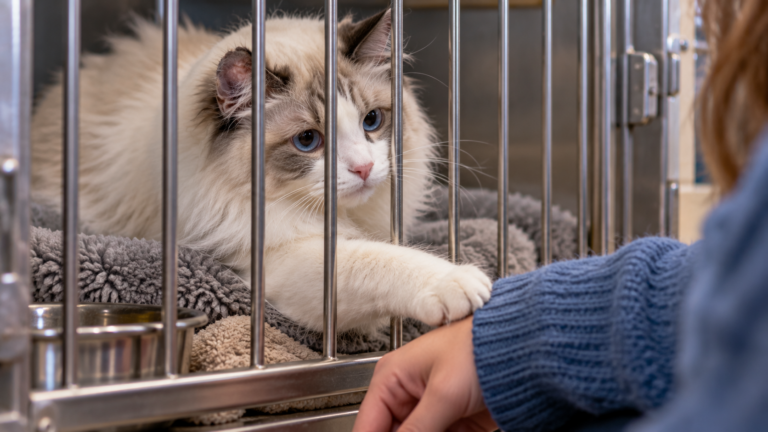
Her liver values gradually improved, although her recovery required continued treatment and careful follow-up.
After several weeks, she was well enough to leave the hospital for foster care.
Her physical recovery was progressing.
But her behaviour revealed another challenge.
The fear that followed her home
Mika was placed with a foster volunteer named Rachel Bennett, who had experience caring for medically fragile cats.
Rachel prepared a quiet bedroom with low furniture, soft bedding, hiding places, and a predictable feeding routine.
At first, Mika spent much of her time resting.
Her body was still thin, but her coat was becoming cleaner and healthier.
She enjoyed being stroked along her cheeks and often approached Rachel when she entered the room.
But Rachel soon noticed a distressing pattern.
Whenever she stood up to leave, Mika became agitated.
The cat would rise abruptly from her blanket and hurry toward the doorway.
If Rachel stepped into the hall, Mika began meowing.
Sometimes she followed as far as she could.
Other times, she stopped at the threshold and cried repeatedly until Rachel returned.
One evening, Rachel went to the kitchen to prepare dinner.
Mika had been sleeping on a cushion beside the sofa.
The moment Rachel disappeared around the corner, the cat woke.
She stood up.
Her ears moved toward the empty doorway.
Then she began calling.
The meows became louder.
Rachel returned to find Mika standing beside the couch, looking toward the hall.
When Rachel sat down, Mika immediately climbed against her leg.
She pressed her face into Rachel’s sleeve and remained there.
Rachel discussed the behaviour with Mika’s veterinarian.
They considered separation-related distress, while recognising that the exact cause could not be established from her history alone.
Instead of keeping Mika constantly attached to a person, Rachel began helping her develop confidence through predictable routines and gradual, brief absences.
She provided familiar bedding, elevated resting spots, food puzzles suited to Mika’s recovery, and a quiet space where the cat could rest undisturbed.
For short periods, Rachel stepped away and returned before Mika became highly distressed.
Over time, she slowly increased those intervals.
Progress was uneven.
Some days, Mika remained calm for several minutes.
On others, the sound of a closing door caused her to begin calling again.
But Rachel continued patiently.
The little passenger who wanted to stay close
To help Mika remain near her during certain household activities, Rachel also introduced a soft, supportive front-worn pet carrier.
It was specifically designed for cats, with breathable mesh, a secure base, and enough space for Mika to rest comfortably.
Rachel first left it open on the floor so Mika could investigate.
She placed a familiar blanket inside.
Mika sniffed the fabric, stepped into the carrier, then walked out again.