PHILADELPHIA, PENNSYLVANIA
When animal welfare officers forced open the door of an abandoned apartment, they expected to find a frightened stray cat.
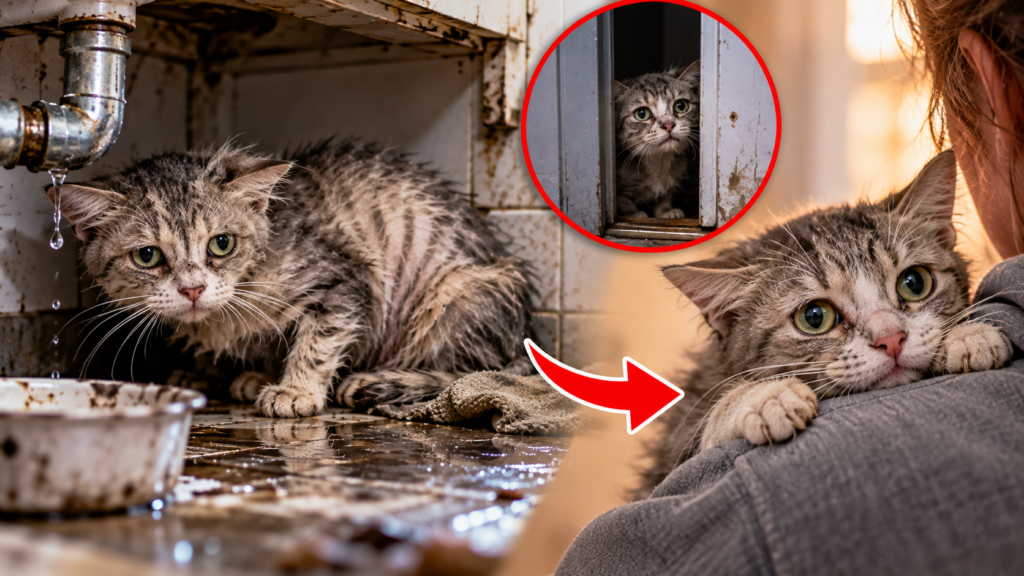
Instead, they discovered a severely emaciated female cat lying beside a leaking bathroom sink, barely able to lift her head.
Her name was Mika.
She had reportedly been left behind when her former owners moved out nearly three weeks earlier.
The apartment was dark, nearly empty, and filled with the smell of stale air and accumulated rubbish. The food bowl was empty. The windows were shut. No one had been coming to feed her.
Mika’s small body had grown frighteningly thin. Her hip bones and spine were clearly visible beneath her dull, dirty fur. When a rescuer knelt beside her, she opened her eyes but did not attempt to stand.
She tried to meow.
Only a faint, hoarse sound came out.
And after she was finally carried to safety, the hardest part of her recovery was only beginning.
The apartment everyone thought was empty.
Mika had once lived in a small third-floor apartment in an ageing brick building in Philadelphia.
She was a four-year-old grey tabby with a white chest, pale green eyes, and a habit of sleeping on the living-room windowsill.
Neighbours occasionally saw her watching the street from behind the glass.
But in early November, the tenants suddenly moved out.
A moving truck arrived one morning.
Furniture disappeared down the stairwell. Boxes were carried into the street. By late afternoon, the apartment appeared empty.
Nobody noticed the little grey cat hiding beneath a kitchen cabinet.
When the last person left, the apartment door was locked.
Mika was still inside.
For the first day, she waited near the front entrance.
Whenever footsteps passed through the hallway, she hurried toward the door and meowed.
Sometimes she scratched at the bottom edge.
But the footsteps continued downstairs.
No one opened the door.
By the third day, her food bowl was empty.
Mika searched the apartment, climbing onto counters and sniffing beneath abandoned cupboards.
She found a few crumbs and traces of dried food, but not enough to sustain her.
The water bowl soon ran dry.
A slow leak beneath the bathroom sink became her only consistent source of moisture.
Drops collected on the porcelain and along a small pipe. Mika learned to return there, licking the damp surface whenever enough water accumulated.
Sometimes she waited several minutes for another drop.
She also began chewing at the edges of discarded cardboard boxes, although the cardboard provided virtually no nourishment.
As the days passed, her strength declined.
Her coat lost its healthy sheen.
Her stomach became hollow, and her movements grew slow.
She stopped jumping onto the windowsill.
Instead, she spent long periods curled beside the bathroom cabinet, where the floor remained slightly damp.