A low growl came from her throat.
Her body curled protectively around the bowl.
Hannah moved away.
Duchess resumed eating.
The rescuers realised that attempting to grab her suddenly could cause considerable distress and worsen her existing injuries.
They positioned a carrier near the pallet and used food to encourage her toward its entrance.
After several cautious attempts, Duchess stepped inside.
The door closed gently behind her.
She crouched in the far corner, breathing rapidly.
The team carried her toward the waiting vehicle.
Inside the carrier, Duchess gave one faint meow.
Then she lowered her head onto her front paws.
The painful work beneath the fur
At the veterinary hospital, Duchess received an extensive medical examination.
She was severely underweight and dehydrated.
Her eyes showed significant inflammation and infection, requiring treatment and close monitoring.
Her skin was irritated beneath large sections of matted fur.
Several areas contained superficial sores.
Veterinarians also found dental disease and signs of poor overall conditioning.
The grooming process would be difficult.
Attempting to pull apart the mats by hand would have caused unnecessary pain.
Instead, the veterinary team carefully clipped away the damaged fur using appropriate equipment and pain management.
Because some mats were tight against her delicate skin, the removal was performed slowly and in stages.
Duchess emerged looking almost unrecognisable.
Most of her long white coat was gone.
Her thin body was visible beneath the short remaining hair.
Small healing patches marked her shoulders, belly, and hindquarters.
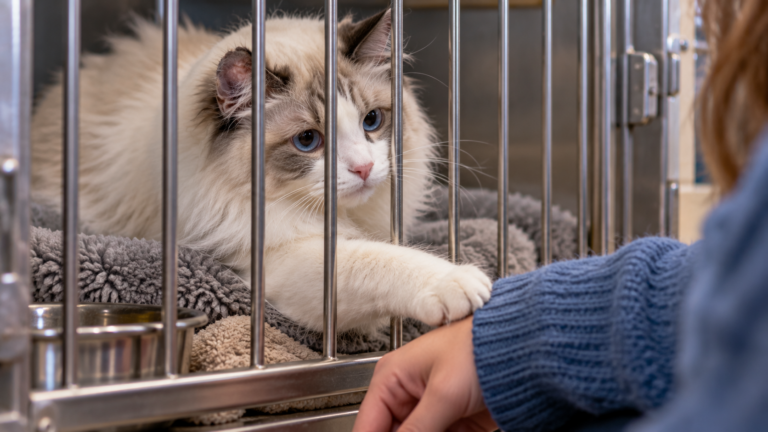
The veterinary staff placed her in a warm, quiet recovery enclosure with soft bedding.
Over the following days, her eyes were cleaned and treated.
Her skin began healing.
She received carefully managed nutrition to help restore her weight.
But feeding time remained difficult.
The bowl nobody was allowed to touch
Whenever a nurse approached with food, Duchess hurried toward the bowl.
She lowered her face into it immediately.
Sometimes she ate so quickly that she paused to swallow, only to resume moments later.
Her ears flattened.
Her shoulders hunched over the dish.
And she growled if anyone came too close.
At first, the veterinary team considered several possible explanations, including food insecurity, stress, pain, and her unfamiliar surroundings.
They also evaluated medical conditions that might affect her appetite.
The staff avoided interpreting her behaviour as proof of any single experience.
But the response was consistent.
Duchess seemed unable to relax while eating.
During one meal, a technician approached to replace her water bowl.
Duchess stopped eating.
She pulled her head lower over the food.
A rough growl came from her throat.
When the technician stepped away, she began eating again.
The staff adapted her routine.
They provided meals in a quiet environment without competing animals.
They avoided interrupting her unnecessarily.